 The forty years that separate us from the Reykjavik summit are only one year shorter than the distance from the summit to the end of World War II. I am not quite sure what to do with this fact, other than to note that most of the summit participants had clear memories of the war as well as of everything that came after, just as people of my generation remember the summit and most of what happened in the four decades since.
Watching US-Soviet summitry from Moscow was quite exciting. By the fall of 1986 it was clear that the Soviet Union was changing, but inside the country things were moving too slowly to tell how dramatic this change would become. Nuclear disarmament, though, was where things were happening right then.
Reykjavik was, of course, a big deal, and I watched Gorbachev's post-summit press conference live with a group of student friends (on a small TV in a cramped room).[1] It was a pretty dramatic experience. Television was our only source of news at the time, so we had absolutely no idea how the summit had ended. And Gorbachev kept us in suspense, starting with a list of things that the Soviet Union had done in the year or so before the summit: the moratorium on nuclear tests, the plan to eliminate nuclear weapons by the year 2000, and the proposal to reduce conventional forces in Europe. He then went on to list all the things that the two leaders had agreed on: to cut their strategic forces in half across the entire triad and to eliminate all intermediate-range missiles in Europe. To make this possible, the Soviet Union agreed to cut half of its heavy ICBMs and not to insist on including the forces of France and the UK in the European arrangement. Gorbachev also stressed that the Soviet Union was ready to accept strict verification provisions.
All this looked like a genuine breakthrough, and it was hard to believe that it was real. But then Gorbachev said that none of this would happen because of the disagreement over SDI. Which was, you know, disappointing. Ultimately, most of the things Gorbachev and Reagan agreed on in Reykjavik were turned into actual agreements--the INF Treaty in 1987, START in 1991, the end of nuclear testing (also discussed in Reykjavik) and the CTBT in the 1990s. But we did not know this at the time.
The odd thing about that disagreement is that it was rather trivial. Reagan and Gorbachev had already agreed that neither party would withdraw from the ABM Treaty for ten years. The question was whether work on missile defense during this period would be limited to laboratories. What counted as a laboratory was never well defined, but it was this condition that became the sticking point. In reality, of course, there was no grand missile defense to deploy ten years after Reykjavik. Or forty, for that matter.
The outcome of the summit has been interpreted in many different ways, but one version seems to stand out--that Gorbachev was so anxious about US missile defense that he was prepared to make serious concessions to stop it. After the summit, Reagan was applauded at home for not giving in to Soviet pressure and for keeping SDI alive.
There is no doubt that Gorbachev worried about the nuclear arms race. It was clear to anyone who lived in the Soviet Union that the economy was not working and something had to be done. I am sure that the idea that the country was spending too much on defense crossed the minds of the political leadership, but I don't think it was the primary motive behind the push for nuclear disarmament.
As far as I can tell, the reasons behind that push were more complex. There was clearly a feeling that things were getting dangerous and might get out of control. I am somewhat skeptical about the Able Archer story, but the air and naval probes, as well as the aggressive rhetoric, were quite real. The sense of danger, by the way, was not confined to the Soviet Union. In many ways it was more acute in the West, if only because people had better information about what their governments were up to and no good way of knowing what the Soviet motivations were.
Not that the Soviet leaders knew exactly where the country was heading. But unlike their US counterparts, they eventually asked themselves, even if only implicitly: "What's the point of all this?" Asking this question, however, was much easier than finding a practical way out of the cycle of confrontation. By the 1980s, the military-industrial complex that sustained the arms race had become a formidable institution that commanded significant material and human resources and was difficult to control.
The defense industry saw the US military buildup as an opportunity, not necessarily as a threat. Boris Vinogradov, one of the designers of the Moscow missile defense system, described to me the reaction of his colleagues to the SDI announcement: "Now we are in business!" And the industry did not really need SDI to push its own projects. Anatoly Savin, the chief designer of the early-warning system, described to me one of his proposals as a system that would have been better than SDI: "SDI would shoot down missiles after launch; my system would hit them before launch." In 1979-1980, Vladimir Chelomey proposed building a missile defense system in space (probably building on Savin's ideas). That proposal was turned down at the time but re-emerged later.
In July 1985, the Soviet government approved a package of major programs that the industry presented as a response to SDI. It was an extensive wish list that included pretty much everything the industry was working on plus many forward-looking programs. (More details are in my old paper "Did Star Wars Help End the Cold War?" or in my even older dissertation.) The package came up for approval only a few months after Gorbachev assumed leadership, so he was not quite in a position to challenge it. To do so, he needed to build a case. Gorbachev already had allies inside the system. For example, Evgeny Velikhov was involved in an internal assessment of SDI and in a public effort to make an argument against the program. Interestingly, the military also largely supported Gorbachev in his disarmament push. But the key was getting the United States on board. And SDI was a very big part of that.
In my view, that was a major reason why Gorbachev was so concerned about SDI in Reykjavik. He needed an argument that he could take to the grandees of the Soviet defense industry to have a chance of slowing down their programs. The irony is that the Soviet Union was probably closer than the United States to the actual deployment of some weapon systems in space, and it was a dangerous process that was not easy to stop.
In the end, despite the disagreement on SDI, the Reykjavik summit showed that the United States was open to a disarmament dialogue, making it easier to divert attention and resources from expensive and dangerous programs. The Soviet Union, of course, made some serious concessions, but it was not like they made the country less secure. If anything, quite the contrary.
Writing this in October 2026, I cannot help noting that many achievements of that time have been lost. There is no INF Treaty or New START; the US is back to the idea of space-based missile defense; tensions are high again. And, of course, Russia is waging a full-scale war against Ukraine. Peace, as it turned out, was easy to lose.
If you want to be an optimist, though, imagine someone in 1983 saying that in a few years the United States and the Soviet Union would agree to eliminate all intermediate-range missiles, drastically reduce conventional forces in Europe, and cut their strategic nuclear arsenals in half. This person would have been laughed out of the room. And yet.
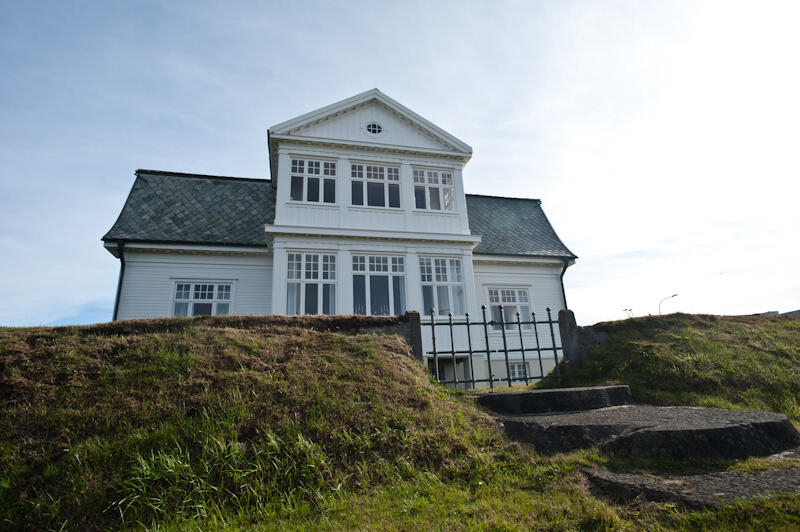
Photo: Höfði House in 2011. It is surprisingly small.
- Here is the transcript of that press conference, put together by Claude from the TV broadcast and the official text published in Pravda.
 Three media outlets - the Sunday Times, Danwatch, and the Dossier Center - published stories about the facility at Kosvinsky Kamen, which is part of the system often referred to, not quite correctly, as the Dead Hand or Perimeter. These stories were picked up by many other news organizations and commentators, often framed as being about the return of the Dead Hand system or as a sign of renewed concerns about US decapitation strikes.
This is a wrong reading, though. You cannot reactivate the Dead Hand since it has never been deactivated. While the evidence does show that Russia recently completed a significant upgrade of the Kosvinsky Kamen facility, nothing suggests that this has changed the basic principles of the Russian command and control system in any way. Neither does this project indicate "paranoia" on the part of the Russian leadership. A survivable command and control system is a normal and even essential part of nuclear force operations.
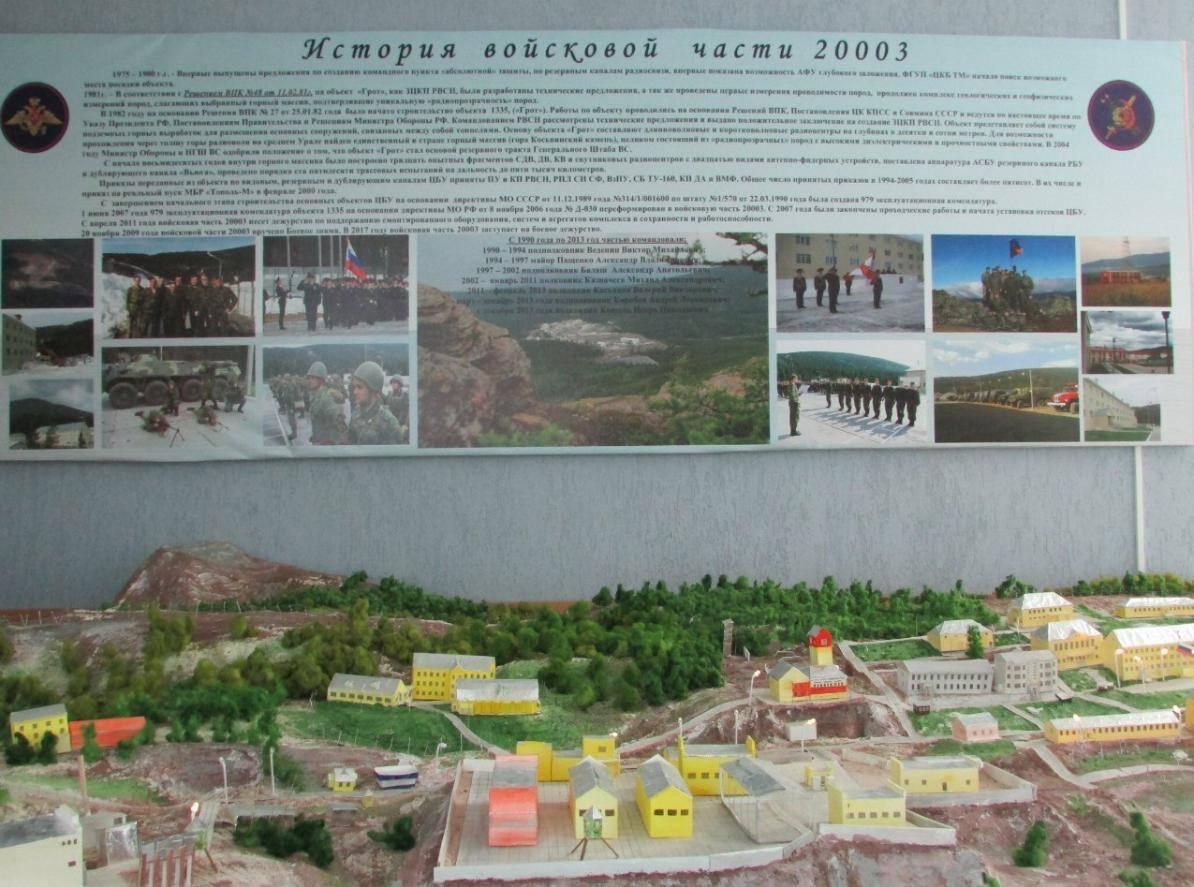
Of the three stories, the Dossier Center one is the most interesting and detailed. It is also the one that avoids the "reactivation" framing (full disclosure - I'm quoted in the story). They also found and published a photo of a poster that shows a fairly detailed chronology of the Kosvinsky Kamen facility, formally known as Object 1335 and operated by military unit 20003. The story is in Russian, but this shouldn't be a problem these days.
First, a brief recap. What is known as the Dead Hand is the general approach to nuclear command and control that was developed in the Soviet Union and, by all indications, is used by Russia today. Since the early 1970s, the primary mode of operation of Soviet strategic forces was retaliation after ride-out. To support a retaliatory strike, the command and control system included a variety of communication channels and reserve command posts. Once a nuclear attack was detected by the early-warning system, the national command authority could issue a so-called preliminary command, which would enable the transmission of an actual launch order. The command centers would then wait for the launch order from the central command post. To guard against decapitation, the command centers could issue an order independently, provided communication with the leadership was lost and they had positive confirmation of an attack, such as the detection of nuclear detonations on Soviet territory.
Perimeter is only one of many communication systems that are used to deliver the launch command to launchers. It includes several command missiles that would fly over the country, delivering the launch order directly to missile silos (and, in later versions, to mobile missile regiments, submarines, and bombers). Those silo-based missiles that survived an attack would launch automatically without the crew going through the launch procedures.
Similarly, the Object 1335 facility is only one of many reserve command posts. Since it is built to withstand a direct nuclear strike (a command post of "absolute" protection), it is an important element of the command and control system but not the only one. For example, the system is known to include airborne command posts.
The system's Dead Hand reputation comes from its ability to deliver the launch order even after a decapitating strike, that is, without an explicit order from the national command authority. The algorithm also makes it possible in principle to operate the system in an automated mode: once the preliminary command is issued, all that is required is confirmation of an attack, with no further human input. This is not that far from the Doomsday Machine as depicted in Stanley Kubrick's Dr. Strangelove.
We know from a Soviet document that the system was not operated in automatic mode back then. The document complained that insufficient attention was being given to the proposal. But even in this proposal, the system would be switched to automatic mode only in the event of a crisis (during a "threatening period"). Presumably this would be done by issuing the preliminary command when the crisis begins (and informing the adversary of it). Normally, the preliminary command would be issued only after a missile attack is detected.
The Dossier Center story quotes a publication by Major-General (ret.) Victor Khalin, who participated in the upgrade of the Object 1335 facility after 2005. According to Khalin, after the upgrade, the system can work "both in automated and in automatic mode" ("как в автоматизированном, так и в автоматическом режиме"). This is not an entirely new capability, however--it existed back in the 1980s as well. Moreover, as far as this (or any other) reserve command center is concerned, the difference between these two modes is not particularly large. If the idea is to issue a launch order when a set of conditions is met, does it really matter how the key is turned? Is it done by an operator sitting deep in a mountain after looking at a red light on the instrument panel, or by the signal from that red light going to the key circuitry automatically?
The automation we should worry about is elsewhere. In the Soviet and Russian case, it is at the point of assessing the early-warning data and issuing the preliminary command. In the United States it's the assessment of the early warning. These steps are already automated, and this is where making things automatic can be a real problem. And the earlier question applies here as well--if people performing the assessment or making the decision act automatically, it may not matter if they are in the loop. There are, of course, examples of operators acting reasonably. The Stanislav Petrov episode is one (even though it's more complicated than usually thought). Another was described by Valery Yarynich in his book: when the Rocket Forces Command Center issued an erroneous preliminary command, only one missile division went through the procedures and raised the readiness level. Others recognized it as an error.
Going back to Object 1335, the chronology of its operations, as seen on the poster found by the Dossier Center, leaves no doubt that the facility has been operating for some time and was never deactivated. The recent modernization probably expanded its capabilities, but nothing suggests that its function has changed.
Below is the translation (by Claude) of the chronology as it appears on that poster. The Russian-language text is in a separate file.
History of Military Unit 20003
1975-1980
The first proposals are put forward for creating a command post of "absolute" protection, using reserve radio-communication channels; the feasibility of deeply-buried antenna-feeder systems (AFU) is demonstrated for the first time. FSUE "TsKB TM" (Central Design Bureau of Heavy Machine-Building) begins the search for a possible site.
1981
Under Military-Industrial Commission (VPK) Decision No. 48 of 11 February 1981, technical proposals are developed for the "Grot" object as a backup central command post (ZTsKP) of the Strategic Rocket Forces (RVSN). The first measurements of the rock's conductivity are carried out, together with a set of geological and geophysical measurements of the chosen mountain massif, confirming the rock's unique "radio transparency."
1982
Under VPK Decision No. 27 of 25 January 1982, construction of Object 1335 ("Grot") begins. The work proceeds on the basis of a VPK Decision, a resolution of the CPSU Central Committee and the USSR Council of Ministers, and continues to the present day under decrees of the President of the Russian Federation, government resolutions, and decisions of the Minister of Defense. The object is a system of underground mine workings housing the main structures, interconnected with one another. Its core is formed by long-wave and short-wave radio centers at depths of tens to hundreds of meters. To allow radio waves to pass through the mass of the mountain, the only suitable massif in the country was found in the Central Urals (Mount Kosvinsky Kamen), composed entirely of "radio-transparent" rock with high dielectric and structural-strength properties.
From the early 1980s
Inside the massif, thirty experimental fragments of VLF, LF, HF and satellite radio centers were built, with twenty types of antenna-feeder devices. Automated combat-control (ASBU) equipment was installed for the reserve channel (RBU) and the duplicating "Vyuga" channel, and around 150 path (over-distance) tests were conducted at ranges up to five thousand kilometers.
1989-1990
With the completion of the initial construction phase of the main objects, under USSR Ministry of Defense directive No. 514/1/001600 of 11 February 1989 and staffing table No. 1/579 of 22 March 1990, the 979th Operational Commandant's Office is created.
Around 1990
The first construction phase of "Grot" is completed around this time, after roughly eight years of work inside Kosvinsky Kamen. The pace of construction then falls off sharply.
February 2000
A command for a real launch of a "Topol-M" ICBM is transmitted through the object. (In all, more than 500 orders were accepted over 1994-2005 across the primary, reserve and duplicating channels by the control and command posts -- those of the Strategic Rocket Forces, the strategic missile submarines of the Northern Fleet, the airborne command post, the Tu-160, and the command posts of Long-Range Aviation and the Navy.)
2004
The Minister of Defense and the Chief of the General Staff approve a provision under which the "Grot" object becomes the basis of the reserve channel of the General Staff of the Armed Forces.
June 2007
Under RF Ministry of Defense directive No. D-030 of 8 November 2006, the 979th Operational Commandant's Office of Object 1335 is reorganized into military unit 20003. From 2007, commissioning work is completed and installation of the combat-control center (TsBU) begins.
20 November 2009
Military unit 20003 is presented with its Battle Banner.
From April 2011
Military unit 20003 stands duty to keep the installed equipment, systems and assemblies of the complex intact and operational.
2017
Military unit 20003 goes on combat duty.
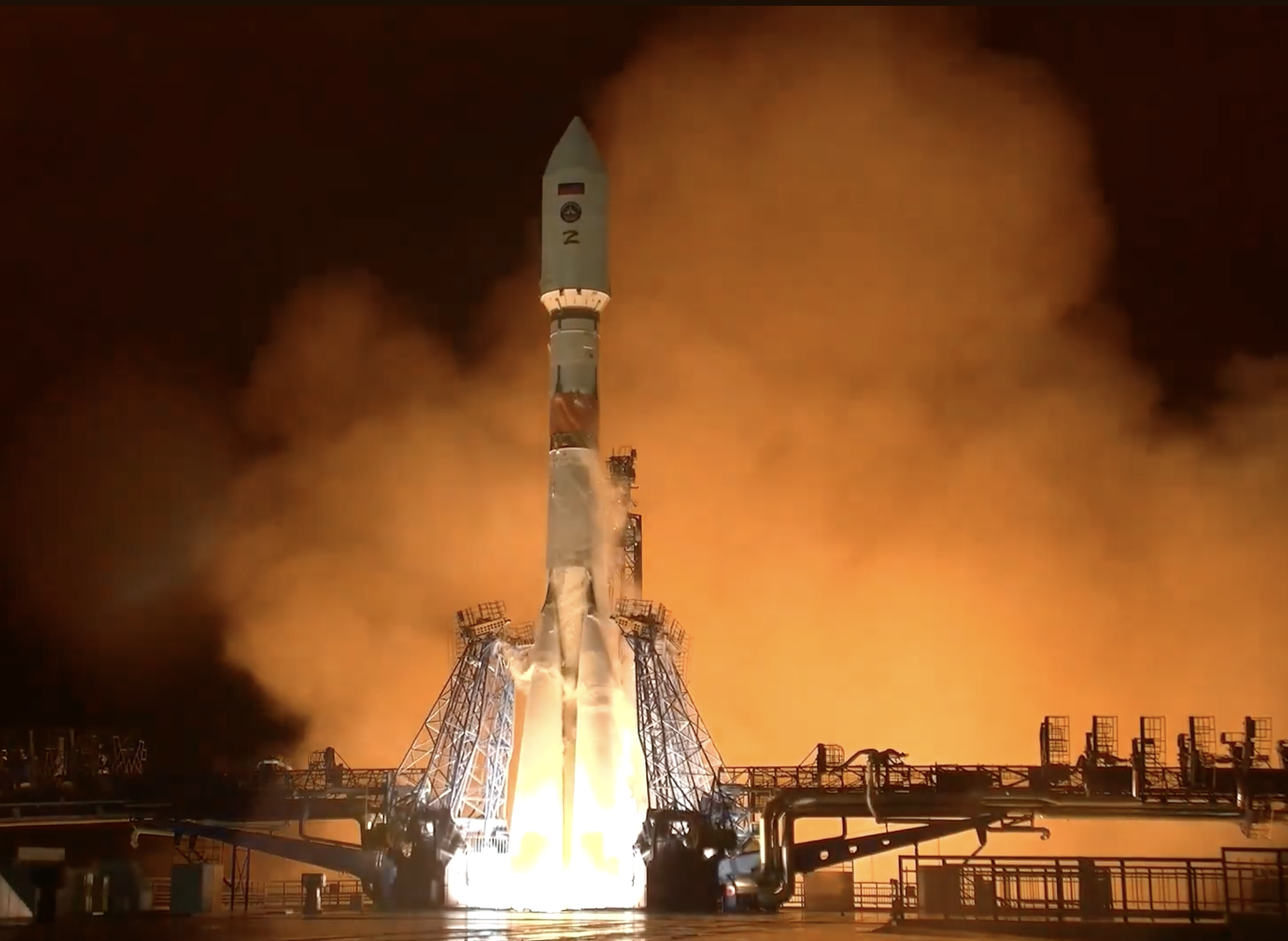 On 18 September 2026, the Air and Space Forces conducted a successful launch of a Soyuz-2.1b rocket from the Plesetsk space launch site (Ministry of Defense video; also on YouTube). The launch took place at about 19:50 MSK (16:50 UTC). The satellite that the rocket and its Fregat boost stage delivered into orbit is believed to be a Glonass-K navigation satellite.
The satellite is likely to be designated Cosmos-2620. It received the international designation 2026-216A and was registered in the NORAD/Space-Track catalog as object 100744. At this point the Space-Track catalog lists the satellite as Object A.
The previous launch of a Glonass-K satellite took place in August 2026.
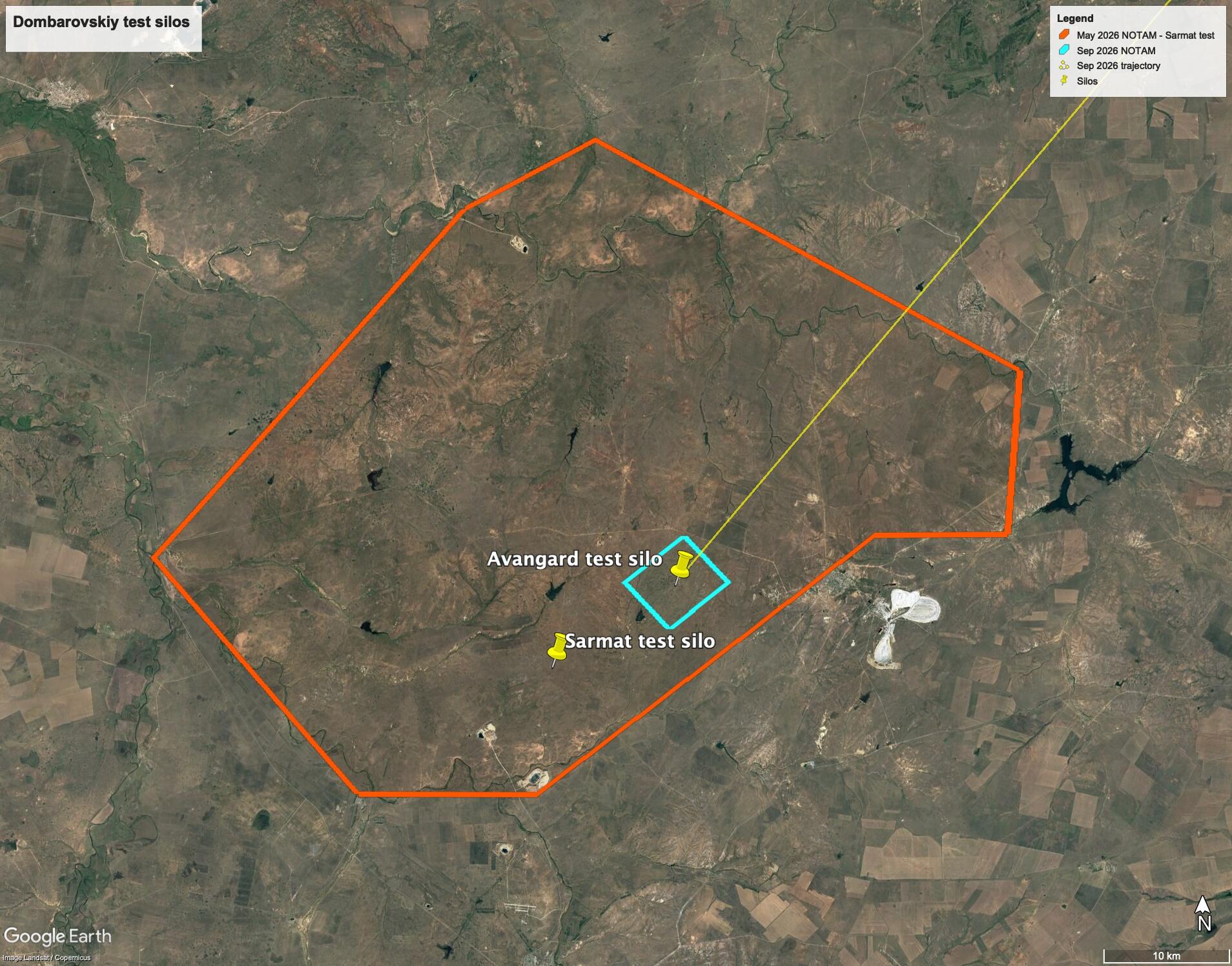 By all indications, Russia was preparing to conduct a test launch of an ICBM from Dombarovskiy/Yasnyy toward Kura during the 3-5 September 2026 window. The evidence suggests that the weapon to be tested was the Avangard hypersonic glider deployed by a UR-100NUTTH ICBM. The launch appears to have been cancelled.
There were several signs of the upcoming test. Russia released NOTAM notifications that covered the 3-5 September 2026 window. The notices were issued for Dombarovskiy, stage drop areas in the Tyumen oblast and Khanty-Mansi Autonomous Okrug (KhMAO), and the Kura test site in Kamchatka. In addition, the local press warned people in the Vikulovo, Vagaisk, and Sorokino regions of the Tyumen oblast of the upcoming test that was supposed to take place on 3 September (with 4 September as a reserve date). The areas around the Kura test site in Kamchatka also received a warning, which covered the period from 25 August to 5 September (there was a Yars launch on 28 August 2026).
The areas closed by NOTAM notifications strongly point to a launch of the Avangard system. First, the area over Dombarovskiy only covers the silo that was used to test Avangard (the most recent test took place in December 2018). The silo that was used to launch Sarmat, identified in the video of the November 2025 failed launch, is not included in the NOTAM area. For comparison, the image shows the area declared for the successful Sarmat test on 12 May 2026.
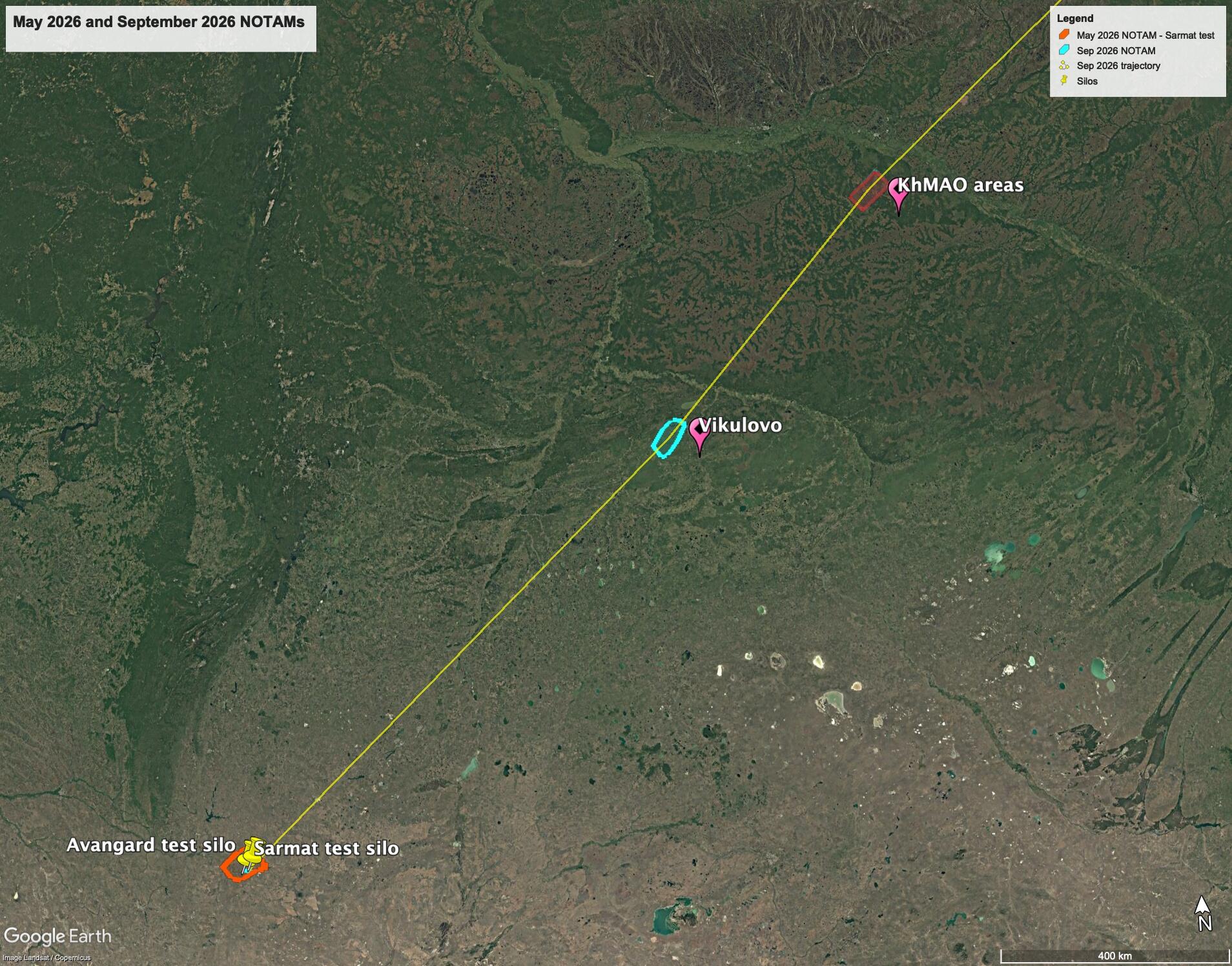 The declared stage drop areas are even more interesting. The notifications released for the May 2026 test and for the September 2026 event include the same (indeed almost identical) area in KhMAO. Apparently, that was the Sarmat first stage drop area in May 2026. But the September 2026 notification also includes the area in the Tyumen oblast, near Vikulovo, which the Sarmat notification doesn't. It appears that this is the actual first-stage drop area and the area in KhMAO plays a different role. (Theoretically, it's possible that this is where the second stage drops after releasing the glider.)
What is notable is that the area near Vikulovo appeared in many previous Avangard launches from Dombarovskiy (the tests were moved there from Baykonur in 2013). The inhabitants of the regions around Vikulovo were warned to stay away in September 2013 (vikulovo.info), February 2015, April 2016 (Krasnaya zvezda), December 2018 (vikulovo72.ru). Some of the public warnings mention that these kinds of tests have been conducted since 2004, which is when the glider made its first public appearance.
The Vikulovo area was also used as a first-stage drop area in R-36M2 tests from Baykonur, like the one in December 2009 (ura.ru). For the Dombarovskiy launches, the role of the first-stage drop area is played by the KhMAO region - both are about 1300-1400 km from the respective launch sites.
As mentioned earlier, if Vikulovo is where the Avangard booster (which is UR-100NUTTH/SS-19 missile) drops its first stage, the KhMAO area would be where the second stage lands after releasing the glider. See Figure 1 in James Acton's article on hypersonic gliders. The flight trajectory has to be adjusted to place the second stage in this specific drop area, but this may not be a factor that limits tests of the glider.
We can say with some certainty that the test did not take place as planned. A success would almost certainly be followed by a public announcement. Avangard has always been too symbolically important a weapon system for Russia to miss an opportunity to bring more attention to it.
It does not seem that the test ended in failure either. Had the launch ended in failure, one would expect NOTAMs to have been cancelled shortly after that. The notifications, however, seem to have quietly expired at the end of the 3-5 September window. It's rather circumstantial but that's all we have at the moment.
The bottom line is that Russia apparently planned to launch Avangard from Dombarovskiy to Kura, but had to scrub the test for some reason. We should expect another attempt at some point.
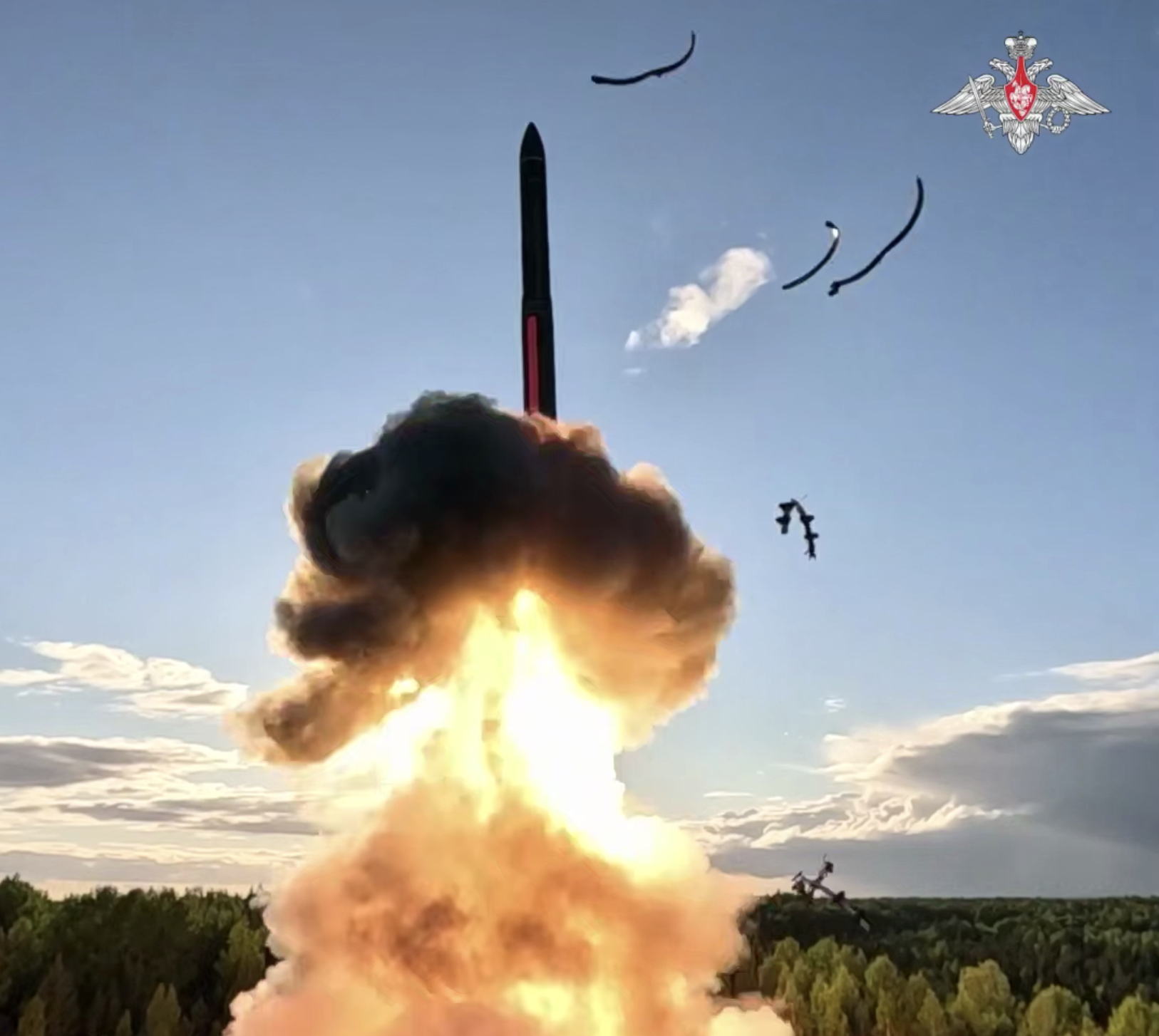 On 28 August 2026, the Russian Ministry of Defense reported conducting a successful launch of the Yars intercontinental ballistic missile from the Plesetsk test site. According to the MoD announcement, all warheads arrived at the Kura test site in Kamchatka. The video of the launch showed that the missile was launched from the Krona shelter.
The MoD also reported that "[t]he purpose of the launch was to confirm the tactical, technical, and flight characteristics of the missile system." The report also said that the missile was brought to the test site from a remote deployment base.
The previous Yars launch was conducted in May 2026, during the strategic forces exercise. At the time, the missile was also launched from the Krona shelter.
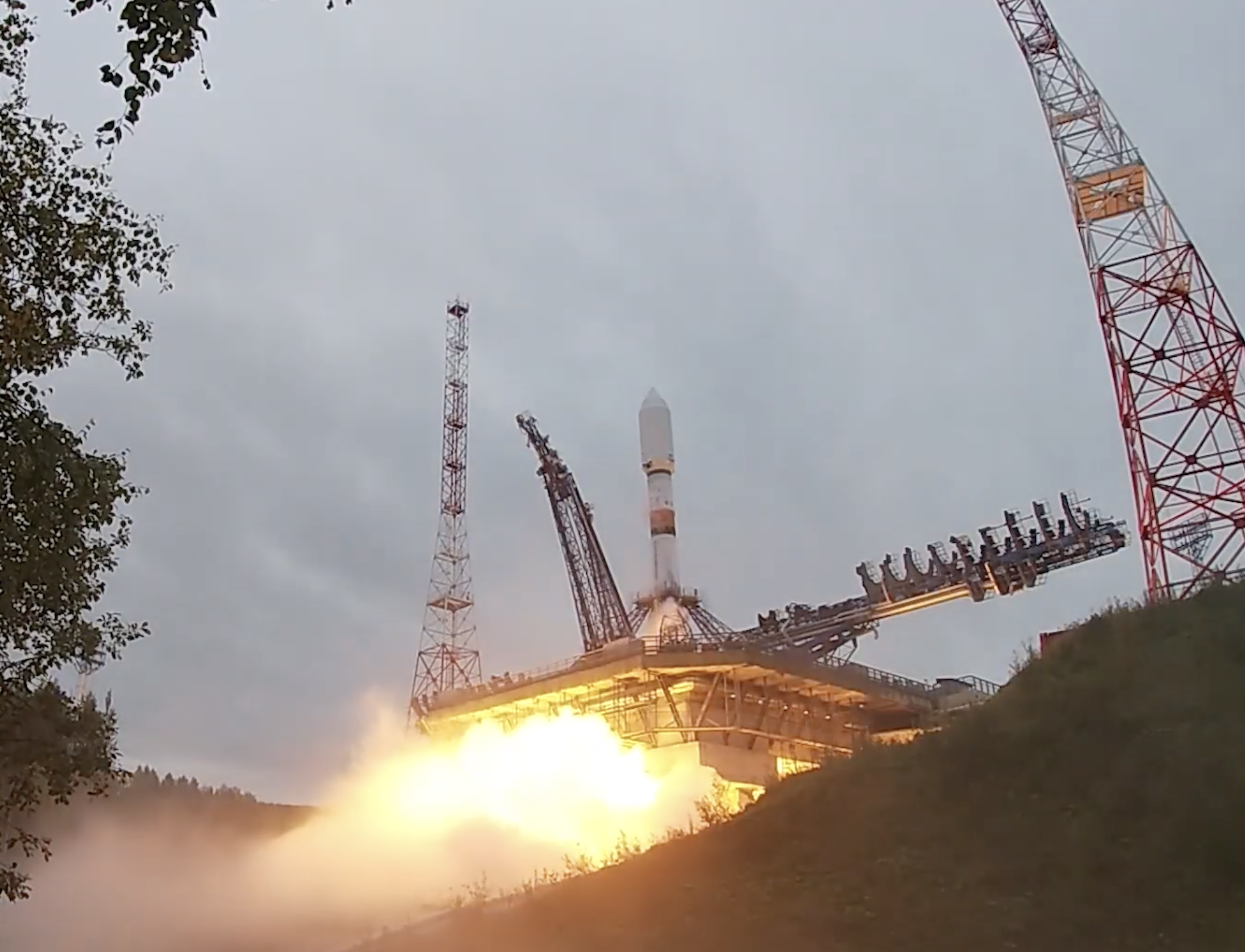 On 24 August 2026, the Air and Space Forces conducted a successful launch of a Soyuz-2.1b rocket from launch pad No. 3 of launch complex No. 43 of the Plesetsk space launch site (Ministry of Defense video; also on YouTube). The launch took place at 05:40 MSK (02:40 UTC). The satellite that the rocket and its Fregat boost stage delivered into orbit is believed to be a Glonass-K navigation satellite.
Russia stopped announcing designations of its military satellites at launch time about a year ago, but it is likely that this satellite will eventually be designated Cosmos-2619. The satellite received international designation 2026-194A and was registered in the NORAD/Space-Track catalog as object 100460. The catalog also lists the satellite as Cosmos-2619.
The previous launch of a Glonass-K satellite took place in September 2025.
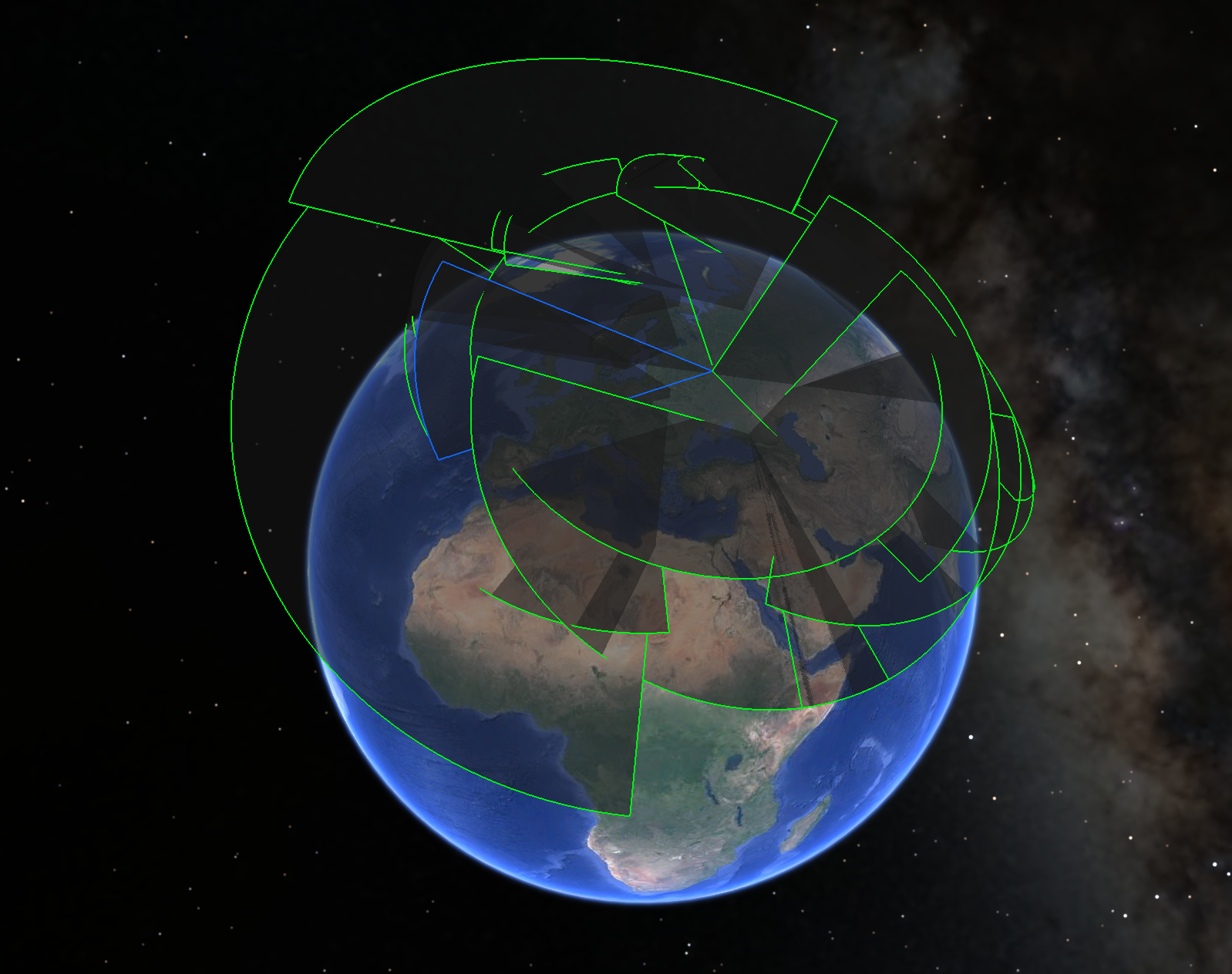 This post updates the Google Earth file with my most recent estimate of the status of Russia's early-warning and space surveillance radar network. The file can be downloaded here: RussianEarly-warningRadars2026.kmz (it's covered by this Creative Commons license). Note that the size of the radar fans does not necessarily correspond to detection ranges.
The current status of some of the radars is uncertain. One example is the Voronezh-DM1 in Olenegorsk (68.091632 34.326424). The most recent image on Google Earth is from 2021 and it shows a largely completed facility. It is also not clear if the older Dnepr at Olenegorsk is still in operation.
One recent addition to the network is a space surveillance Razvyazka radar in Chekhov, which began operations in the summer of 2023.
At least one radar site, Armavir, was attacked by Ukrainian drones on 23 May 2024. The attack appears to have damaged both Voronezh-DM radars located at the site. It is not known whether the radars have resumed operation after the strike. There were also reports about an attack on the Voronezh-M radar in Orsk on 26 May 2024. It is not clear, however, whether the radar site was damaged.
 On 19 May 2026, the Russian Ministry of Defense announced that it will hold an exercise "to prepare and use nuclear forces in the face of the threat of aggression" in the period of 19-21 May 2026. It was said to include "over 200 missile launchers, more than 140 aircraft, 73 surface ships, and 13 submarines, including 8 strategic missile submarines." The scale suggested that the non-strategic part of the exercise and Belarus' participation is accounted for as well.
The objective of the exercise may deserve a note - a more accurate translation would be "on the preparation and employment of nuclear forces under conditions of a threat of aggression." This formula has not been seen before. What is notable here is the use would not be in response to aggression, but rather "under a threat of aggression."
The timing of the exercise is also rather unusual. Normally, large exercises of strategic forces take place in the fall. One infamous exception is the exercise that was moved from the fall of 2021 to 19 February 2022, a few days before the full-scale invasion of Ukraine. It should be noted that the 2022 exercise involved non-strategic nuclear weapons, just like this one. On the other hand, there was a precedent of an exercise held in May, in 2014, so it is not entirely unprecedented.
Judging by NOTAMs, the original plan was to conduct the exercise around 9-11 May 2026. It is not clear why it was postponed.
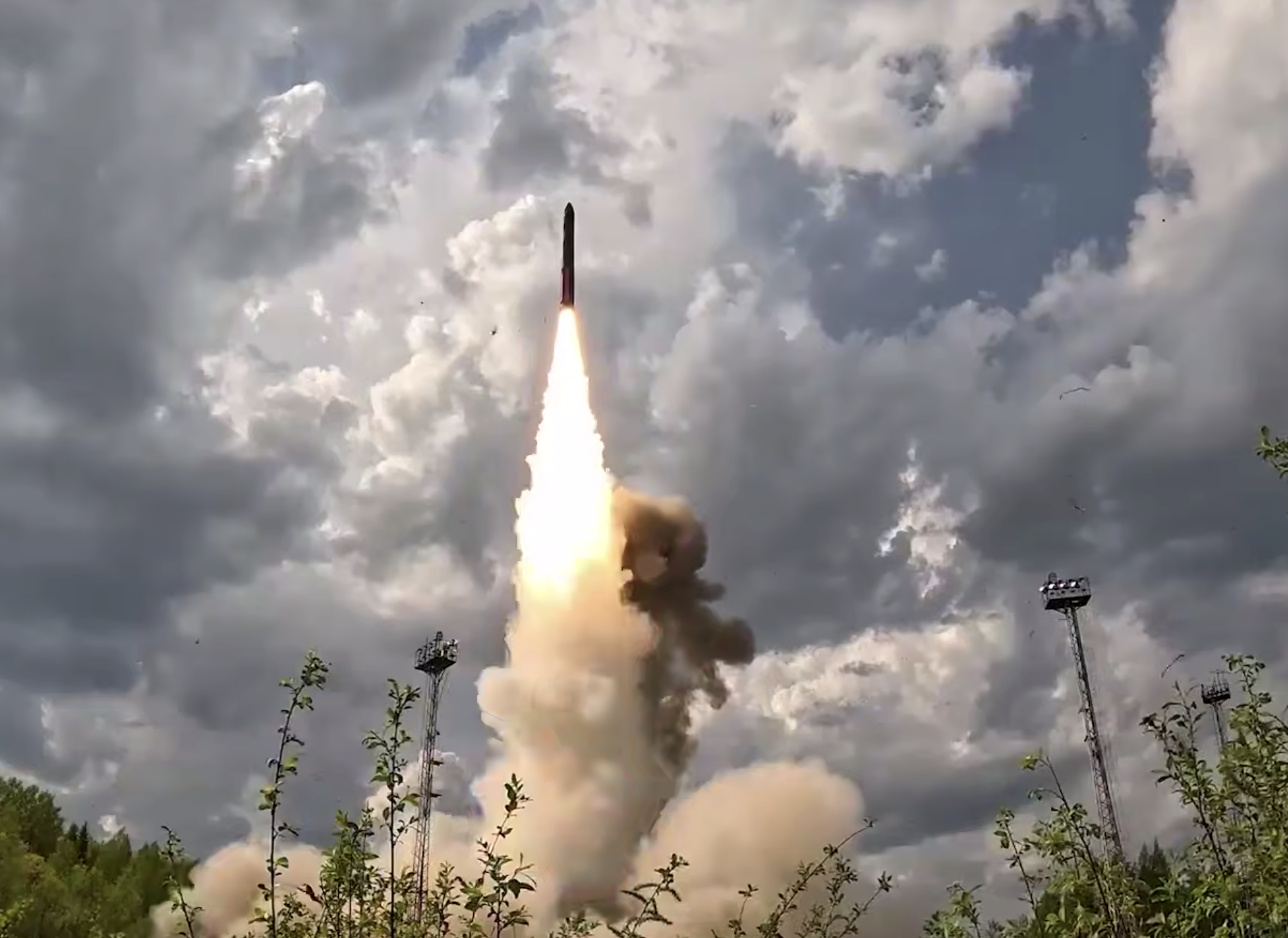
In the end, the strategic part of the exercise took place on 21 May 2026. It involved a launch of a Yars missile from a Krona shelter at the Plesetsk test site. The previous Yars launch was conducted as part of the October 2025 exercise.
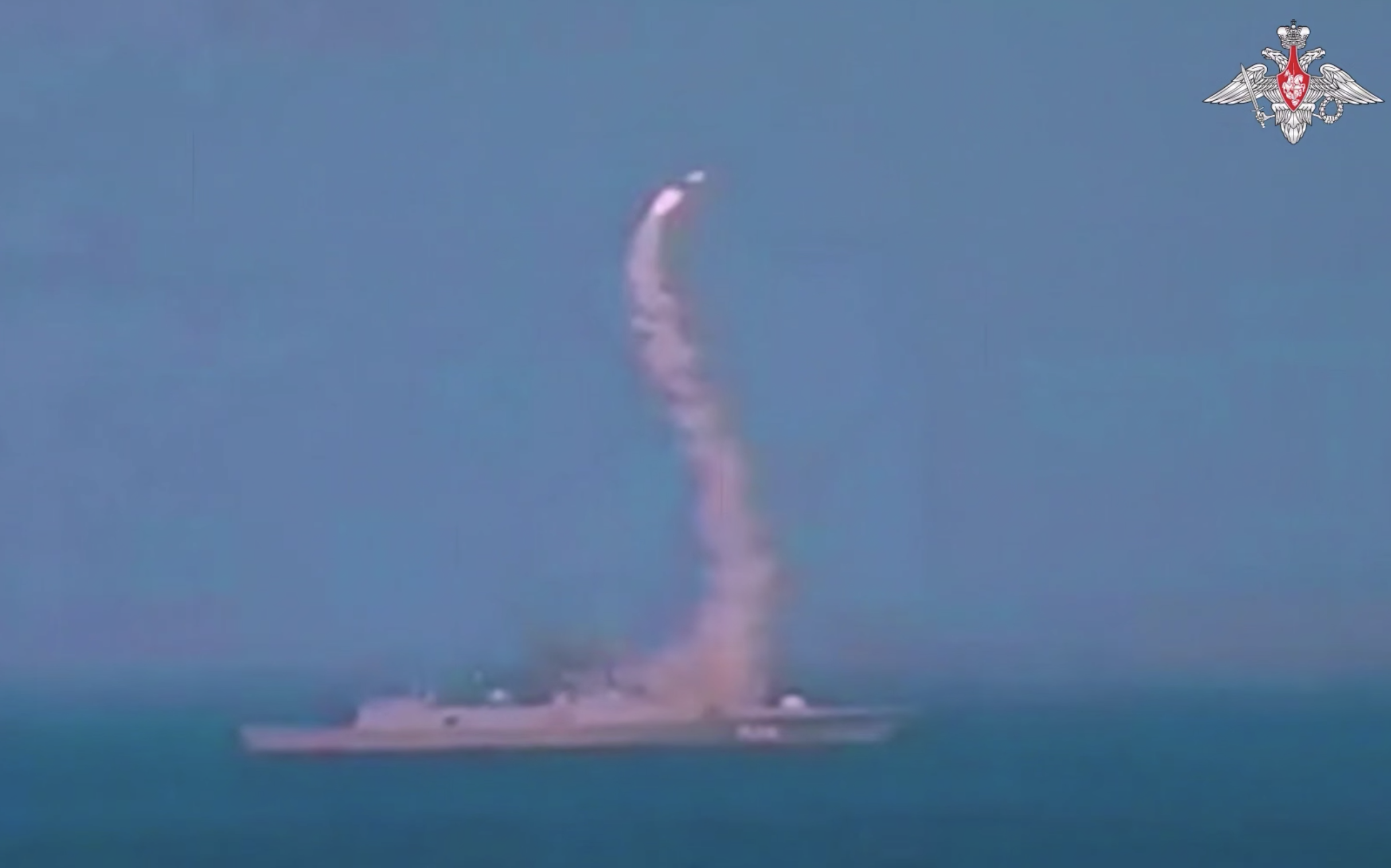 There were two launches from the Barents Sea - of a Tsirkon missile from a surface ship and of a Sineva SLBM from a Project 667BDRM/Delta IV submarine. The previous launch of Sineva took place in October 2025.
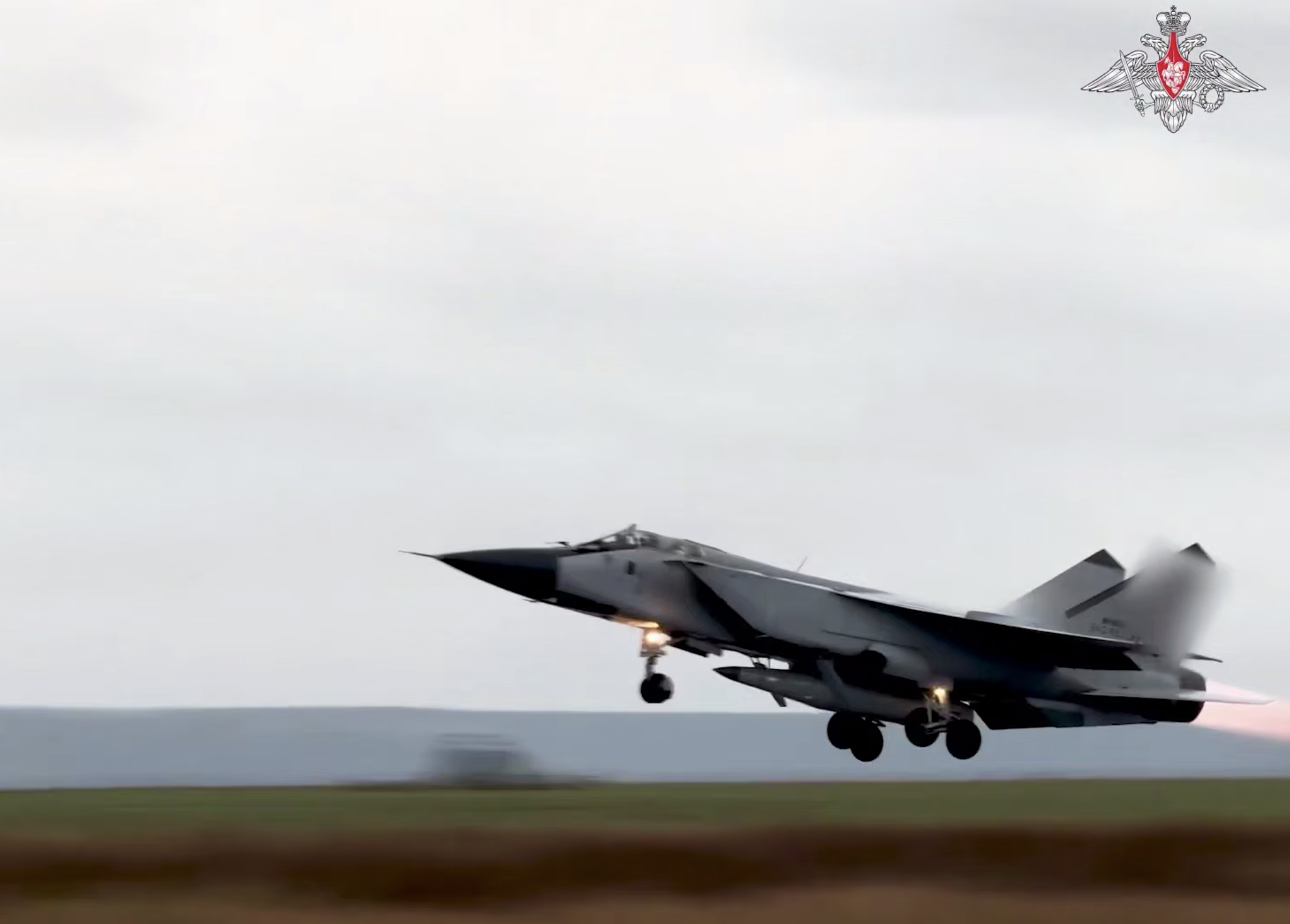 The aviation component of the exercise included Tu-95MS bombers taking off from the Ukrainka base to launch their air-launched cruise missiles and a MiG-31 aircraft taking off with a Kinzhal missile (the originally posted video showed the process of loading Kinzhal on the aircraft).
Finally, Belarusian crews conducted a launch of an Iskander ballistic missile from the Kapustin Yar test site.
It is not clear why Russia held a major strategic exercise in May and not in the fall as it normally does. The parallel with 19 February 2022 looks rather ominous, especially if you note that 2022 was also unusual in that it included launches of Tsirkon (from a submarine) and Kinzhal. Back then there was also a launch of a Kalibr cruise missile (from a submarine). Nothing similar happened this time. And it was cruise missile Iskander in 2022, not the ballistic one. But these differences are not significant. I guess we will find out soon if there is something to it.
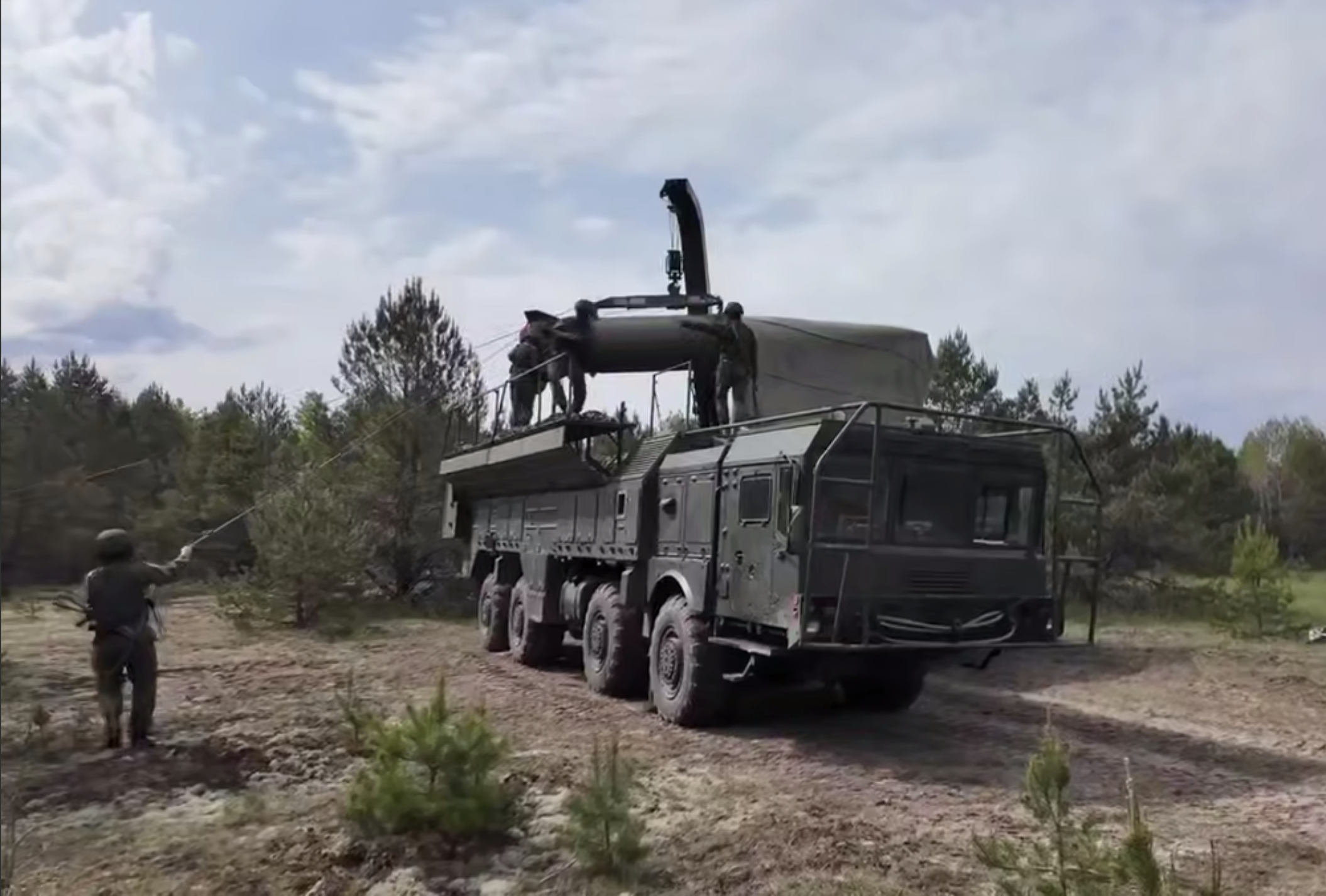 On 18 May 2026, the Belarusian Ministry of Defense announced the start of an exercise of "military units involved in the combat use of nuclear weapons and nuclear support." The objective was described as checking the readiness of the troops and "the organization of the combat employment from unplanned areas." The announcement said that the exercise will test the procedures of "delivery of nuclear weapons and their preparation for use," which will be done in coordination with the Russian military. The Russian Ministry of Defense did not say anything about its role, although the 12th Main Directorate took notice of the Belarusian exercise.
The next day, on 19 May 2026, the Russian Ministry of Defense announced that it will hold its own large-scale exercise "to prepare and use nuclear forces in the face of the threat of aggression" in the period of 19-21 May 2026. It was said to include "over 200 missile launchers, more than 140 aircraft, 73 surface ships, and 13 submarines, including 8 strategic missile submarines." Belarus' participation was mentioned as well.
The strategic part of the exercise apparently had to wait for the Russian president to return to Moscow from his visit to China. But the non-strategic element went ahead without him.
On 20 May 2026, the Russian MoD released a video (probably recorded on 19 May) of its units involved in various activities. The announcement stated that "the delivery of nuclear munitions to field storage points of missile brigades' positioning areas was ensured." The missile brigades in question apparently were those with Iskander cruise missiles, shown in the video (by the way, the containers appear to be Type 3 in Jeffrey Lewis' classification).
All this was separate from what was happening in Belarus. Russian MoD mentioned training related to "nuclear weapons deployed in Belarus," but made it reasonably clear that it is a separate activity. According to the Belarusian MoD, on 20 May 2026, the combat crews of units that operate Iskander ballistic missiles "carried out a set of measures to prepare for the receipt of special munitions and their mating with missiles." It is not entirely clear whether these measures were limited to preparations or the actual receipt and mating took place. My reading of the text is that it is the former - no Russian troops that would deliver the weapons are mentioned. The announcement also mentions aircraft, which (two Su-25) were also in the video. The aircraft were said to perform "imitation bombing with special munitions," but there was nothing to suggest that Russian 12th GUMO units were there to deliver anything.
The Russians apparently came at night. The video released by the Belarusian MoD in the morning of 21 May 2026 showed what was identified as trucks of the 12th GUMO. They appear in the second half of the video (the first half shows some Belarusian trucks that do not seem to have anything to do with anything). The video appears to show personnel opening armored back doors of the truck, probably to prepare the warhead for mating with the missile.
A few words about how the preparation for use of Iskander ballistic missiles appears to be structured. Missiles and warheads arrive at the designated meeting point (apparently the "field storage points" mentioned earlier) separately. In this case, missiles are operated by the Belarusian military, in Russia these would be Russian units. Warheads, however, are always handled by the 12th GUMO personnel. Once at the meeting point, the 12th GUMO troops mate warheads with missiles. This procedure may require a special assembly bench, but it's possible that it can be done while the missile is on the transporter vehicle.
Once the warhead is on the missile, the transporter is probably guarded by the 12th GUMO crews. When the higher command orders bringing the system to the highest degree of readiness, which may include authorization to launch the missile at a designated target, the missile and nuclear crews transfer the missile from the transporter to the launcher. As I understand it, it would be after this procedure that the 12th GUMO transfers custody of the nuclear warhead to the missile crew, Belarusian in this case. Not earlier.
The procedure of releasing weapons to aviation is probably similar, the main difference being that there is no need to transfer a weapon to a transporter vehicle. The procedure with Iskander cruise missile must be different, since the missile is stored and transported in a container and the weapon section is not easily accessible. And that difference may account for the fact that there are no cruise missiles that have nuclear warheads assigned to them in Belarus. But that is for another post.
This procedure does not require nuclear warheads to be stored near missiles. Indeed, I believe that the plan is that if time comes the warheads would be brought to Belarus from Bryansk. It is a drive that can take several hours, but it is not that unusual for the 12th GUMO. There is also an option of keeping warheads at the storage site in Asipovichi, but we have not seen a confirmation that this is what is being done.
Now, naturally, one would assume that these kinds of exercises do not involve actual nuclear weapons and everything is done with training models. But that is not what the Chief of the General Staff said on 21 May 2026 before the strategic part of the exercise (my translation):
In the first phase of the exercise, from May 19 to 20, a snap exercise of nuclear forces was conducted. Troops and forces were brought to the "Full" combat readiness, and the delivery and transfer of nuclear munitions to Russian and Belarusian units that can use nuclear weapons in combat was carried out.
This seems to suggest that the exercise went as far as to actually get to the point of mating actual warheads with missiles and loading these missiles on launchers. I hope it didn't proceed to transferring the custody of weapons to the Belarusian crews.
In any event, moving live nuclear weapons around during exercises is not a good idea. The United States, of course, did a lot of this and much worse, like having continuous bomber patrols with nuclear weapons (and a lot of accidents). Interestingly, France uses actual nuclear warheads during exercises but only within the airfield. My impression has always been that Russia is on the side of caution in these matters. Maybe not anymore. Some guardrails, however, still seem to be in place, like not flying with nuclear weapons.
To conclude, there is still a puzzle about the timing of the exercise. Why did Belarus start a day early? Note that the Chief of the General Staff said that the first part of the exercise, from 19 to 20 May, was a "snap exercise." I would say it is not entirely impossible that Belarus in a way forced Russia to add the non-strategic part to the strategic exercise it was planning for some time. I would recall that in 2024, Belarusian president in effect invited his military to the exercise that Russia announced. I am not saying this is what happened, though.
Much more important questions are, what happened to all those nuclear warheads that have been "delivered and transferred" to the units that can use them. Are they still there? They could probably stay in those "field storage points" for some time, maybe weeks. And what are those "conditions of a threat of aggression"? I guess we will know in a few days.
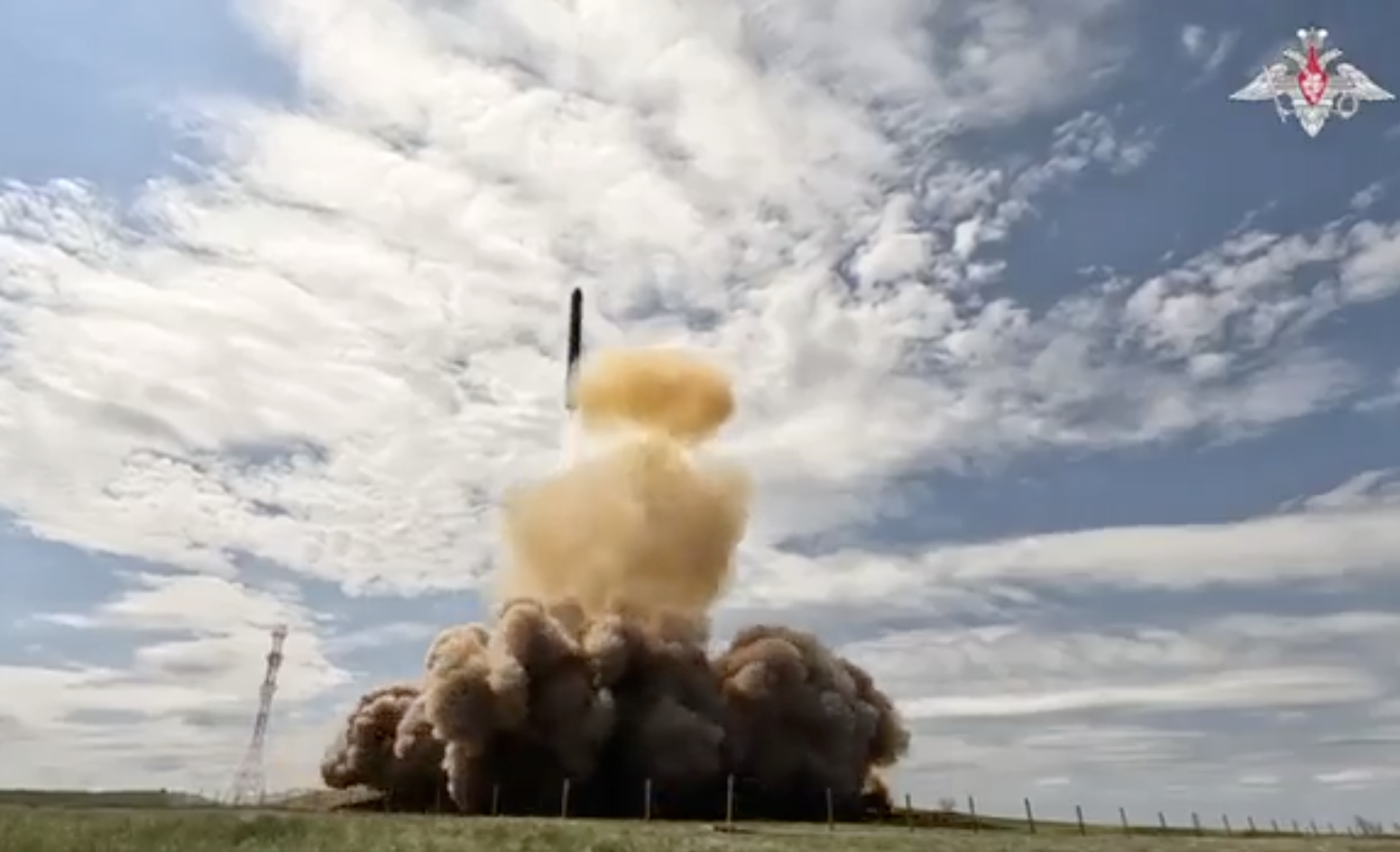 On 12 May 2026, at 11:15 MSK (08:15 UTC), the Strategic Rocket Forces conducted a successful test launch of the Sarmat ICBM (video of the launch). The missile was launched from a silo of the Dombarovskiy/Yasnyy missile division toward the Kura test site in Kamchatka.
This is the second successful test launch of the Sarmat missile. The first one took place in April 2022. The second successful test came after a series of failures. Two are known - the launch attempt in September 2024 destroyed the test silo in Plesetsk; the failed test in November 2025 was captured on video. There seems to have been a failed test in February 2023 (it was confirmed by US sources). There may have been another one, in October 2023, but it was not confirmed by a reliable source.
The program began in 2010-2011 and is seriously behind schedule (see an earlier post for the recap of the developments). The commander of the Strategic Rocket Forces reported to the president that "the first missile regiment equipped with the Sarmat system [will be] placed on combat duty in the Uzhur formation, Krasnoyarsk Territory, by the end of the year."
It is likely that the first missiles, probably two of them, will indeed be deployed with the Uzhur division by the end of 2026. It is also possible, although somewhat less likely, that the flight tests of the missile will continue.
The book