 Getting a good estimate of the status of Russian strategic nuclear forces has become very difficult after Russia suspended the implementation of New START in February 2023. The last data exchange reflected the status of its forces on 1 September 2022. Russia declared having 1549 deployed warheads, 540 deployed launchers, and 759 total launchers.
The FAS team, of course, continues to publish their estimates - they remain the best source for all nuclear-related numbers. I have used their estimates, of course, but my take may be a bit different.
The biggest question is the status of the ICBM force. Or, rather, of its silo-based part. More precisely, the question is, what is happening with SS-18/R-36M2, which is responsible for a substantial portion of Russian strategic warhead count.
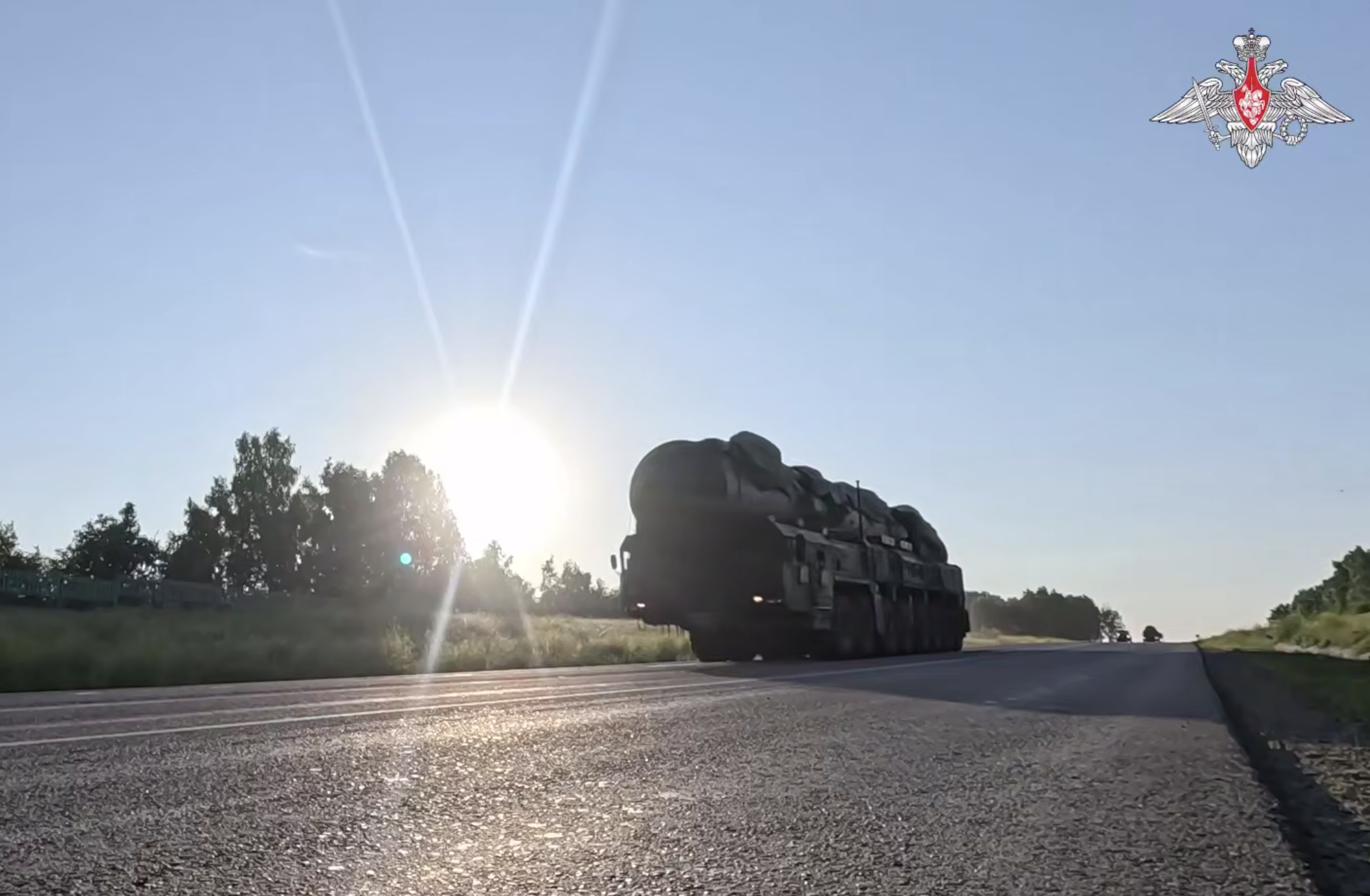
With other missiles, the situation is reasonably non-controversial - Russia completed the withdrawal of old SS-25/Topol mobile missiles in 2023 and now operates seven divisions with 18 to 36 Yars missiles each. The only exception is the 54th missile division in Teykovo, which has 18 Topol-M and 18 Yars ICBMs. So, it's a total of 18 mobile Topol-M ICBMs and 180 mobile Yars. The former are single-warhead, the latter are believed to carry four warheads.
In addition to mobile Yars ICBMs, Russia has been deploying some in silos. This deployment began in Kozelsk in 2014. At the end of 2025, the Rocket Forces announced that the deployment in Kozelsk has been completed. The division now has 30 missiles of this type.
Yars missiles are now being deployed in Tatishchevo as well. According to the commander of the Rocket Forces, the first regiment began combat duty there in 2025. It does not seem that the regiment has the full complement of ten missiles yet, though.
It is not clear if Yars missiles are replacing silo-based Topol-M ICBMs that are deployed there. The deployment in Tatishchevo started in 1997 and was completed in 2012, with 60 missiles placed in silos. It appears that all these missiles are still in service. The oldest Topol-Ms are about 27 years old and we know from the SS-25/Topol experience that even though it's close to the limit, these missiles can probably stay in service a bit longer. The last firm data on Topol was that its service life was extended to 26 years, but in the end they stayed in service for closer to 30, retiring in 2022-2023.
Now the difficult part - the missile divisions in Dombarovskiy and Uzhur. What we can say with certainty is that there are 12 Avangard systems deployed in Dombarovskiy (coordinates of Avangard silos are in this post). These are older SS-19/UR-100NUTTH missiles that carry one hypersonic glide vehicle each.
In addition to this, there are three regiments, with six silos each, of SS-18/R-36M2 missiles in Dombarovskiy. The silo positions seem to be intact, but it's hard to tell if there are missiles there and what is the status of these missiles.
A similar question can be asked about the division in Uzhur. The division has 28 intact silos, six of which are being modified to deploy Sarmat (see the FAS post for more detail and images).
The plan for Sarmat appears to be to deploy 46 missiles, so all R-36M2 silos at Dombarovskiy and Uzhur would be used for Sarmat. The Sarmat program, of course, has encountered some serious problems, so it will not be ready for deployment for some time.
The question is then, are SS-18/R-36M2 missiles still operational? The deployment of this version of the SS-18 missile began in 1988 and the youngest of them, produced around 1992, are more than 33 years old now. Back in the day, in 2010, the Rocket Forces were somewhat optimistic about extending the lifetime of the missile to 33 years, but later said it would only be 30.
Strictly speaking, for a system with no moving parts, which an ICBM sitting in a silo essentially is, life extension can be done by adjusting the reliability of the system. Yes, by the end of, say, the fifth decade only a small fraction of missiles would be able to start, but how do we know how many? Normally, of course, these things are confirmed with regular flight tests, but R-36M2 hasn't been flight tested for more than a decade. The last record that I can find was a launch during an exercise in 2013. Another option is to closely monitor the health of a missile without tests. One of the problems here is that the R-36 missile line was produced in Ukraine and this kind of evaluation would be rather difficult without Ukrainian experts (although maybe not impossible). In better times, in 2008, Russia and Ukraine, in fact, agreed to do just that. Needless to say, this kind of cooperation became impossible after 2014. Indeed, it may not be a coincidence that there were no R-36M2 launches after 2013. [UPDATE: Colleagues reminded me that the are moving parts - R-36M2, unlike its predecessors, was kept in the high degree of readiness, with its gyroscopes spun up.]
One data point here is the R-36M2 predecessor, R-36MUTTH. Missiles of this type were deployed in 1979-1986. They have been gradually withdrawn from service, but some were used as space launchers, known as Dnepr. The last Dnepr launch took place in 2015, so the missile was about 30 years old. This suggests that 30 years is not a limit for R-36M family of missiles. However, it does not tell us anything about the possibility to extend the lifetime beyond that.
One problem is that if all R-36M2 ICBMs remain in service with their nominal load of ten warheads per missile, there is no way Russia could have complied with New START limits. Together with newer missiles, like Yars and Topol-M, ICBM warheads alone would almost reach the New START limit for the total deployed warheads (1370 vs. 1550). But that's if R-36M2 missiles are deployed. My take is that they are not. Indeed, if we assume that the silos in Dombarovskiy and Uzhur are empty, we will get quite close to the 540 deployed launchers Russia declared in 2022.
This means that as of early 2026, Russia has 112 silo-based ICBMs (Topol-M, Yars, and Avangard) and 198 mobile ICBMs (Topol-M and Yars). It's worth noting that there seem to be different versions of Yars, sometimes referred to as Yars-M or Yars-S. It's quite difficult to tell, however, whether these are deployed and where.
How many warheads these ICBMs carry is a different question. To stay within New START limits, Russia had to "download" some (or even all) of its MIRVed missiles, ICBMs as well as SLBMs. More about it at the end of the post.
Submarines are much easier to count. After Knyaz Pozharsky was accepted into service in June 2025, Russia has eight submarines of the Borey and Borey-A (Project 955 and 955A) class. Each of these carries 16 Bulava SLBMs, so the total is 128 Bulava missiles. There are also five older submarines of the Project 667BDRM/Delta IV class, each with 16 R-29RM (Sineva or Liner) missiles. In addition, one Project 667BDRM submarine is in overhaul. The last submarine of the even older Project 667BDR/Delta III class, Ryazan, was withdrawn from service some time after 2021. This means that the total number of deployed SLBMs is 208. They can carry up to 1088 warheads, but as is the case with ICBMs, they probably carry fewer.
The air-based leg of the strategic triad had a rough year. The FAS team estimated that at the beginning of 2025, Russia had 52 Tu-95MS aircraft and 15 Tu-160/Tu-160M. However, some aircraft were lost in the Pautina/Spiderweb operation carried out by the Security Service of Ukraine (SBU) on 1 June 2025. The operation targeted airbases with Tu-95MS and Tu-22M3 bombers. The exact number of Tu-95MS aircraft lost that day is unknown, but it has been estimated that ten Tu-95MS were destroyed.
Now to the number of warheads. We know that Topol-M is a single-warhead missile. Avangard is also considered to be a single-warhead missile. Each strategic bomber is counted as one warhead. As for MIRVed ICBMs and SLBMs, it is believed that the nominal load of Yars is four warheads, Bulava can carry six warheads, and R-29RM - four. Had all missiles carried their full load, the total number of deployed strategic warheads would have been 2115, which is way over the New START limit of 1550. One explanation, of course, is that Russia does not comply with this limit, but I do not believe this is the case (I know that there are many people who would happily insist that it is, but that's a discussion for a different post).
A more realistic option, in my view, is that MIRVed missiles do not carry a full load of warheads. This allows Russia to stay within the New START limits and gives it the capability to reasonably quickly increase the number of warheads if a decision is made to do so (the United States, of course, has a similar capability of its own). The actual load of missiles is hard to know, so I would (rather arbitrarily) assume that mobile Yars ICBMs carry four warheads (i.e. their full load) and silo-based ones - three. R-29RM can be downloaded to two warheads, and Bulava - to three. With bombers counted as one warhead each, this gives a total of 1531 deployed warheads, of which 930 are on ICBMs, 544 on SLBMs, and 57 are on bombers.
The book

Post a comment