 Oreshnik is an elusive missile. It shows up in various statements and there are some pretty tangible signs of its existence, but it is still not quite clear what the actual status of the missile is.
The most notable recent appearance of Oreshnik was in the Belarusian leader's 18 December 2025 address, in which he announced that Oreshnik was delivered to Belarus on 17 December 2025 and that it is "being placed on combat duty." Is it really?
My take is that there are reasons to be skeptical. Yes, there is strong evidence of preparations for the deployment, such as the potential deployment site found by Jeffrey Lewis' team (and confirmed by US intelligence). But there are also reasons not to read this evidence too literally, at least at this point in time.
This post is an attempt to collect what we know about Oreshnik to see how various pieces of the story fit together.
The name Oreshnik first appeared on 21 November 2024, when Russia used this missile to strike the Yuzhmash plant in Ukraine. (Here is a video of warheads hitting their targets.) In a special televised address the president of Russia described the strike as a test of a medium-range "non-nuclear hypersonic ballistic missile."
The missile was launched from Kapustin Yar, which is about 800 km away from Yuzhmash. This means that it is indeed a medium-range missile. Note that the reason it was described as a test is that technically the Russian INF moratorium proposal was still on the table. Apparently, the (not quite convincing) logic was that a test is different from deployment, so it would not violate the moratorium. Speaking at a meeting with designers on 22 November 2024, the Russian president confirmed the very narrow reading of the moratorium when he said that Oreshnik is only one of "a whole line of medium- and shorter-range systems." Nevertheless, the framing of the launch as a test was an interesting detail.
According to the report of the commander of the Strategic Rocket Forces at the 22 November 2024 meeting, the missile was developed in accordance with the presidential decision of July 2023. It appears that the missile was tested at least twice before November 2024 - in October 2023 and June 2024 (MilitaryRussia.ru citing a report by the Ukrainian Main Intelligence Directorate).
The Pentagon assessed that the missile was based on RS-26 Rubezh. The Pentagon spokesperson also said that "the United States was pre-notified briefly before the launch through nuclear risk reduction channels." Technically, since the missile was not a true ICBM, Russia was not under an obligation to send a notification, but it apparently decided to do so to avoid potential misunderstanding. If the missile is indeed based on RS-26, its signature during the boost phase would be very similar to Yars (since RS-26 was said to be based on RS-24 Yars). One can never be too careful. The Kremlin spokesman later said that the notification was "an automated warning [that] was sent 30 minutes before the launch." This is most certainly an error - these notifications are not automatic, and by all indications the warning was sent about 24 hours in advance, as required by the US-Russian agreement. We know that rumors of an upcoming ICBM launch were circulating in Ukraine the day before the strike.
The Belarusian involvement in the Oreshnik story started in December 2024. After a bilateral meeting on 6 December 2024, the president of Belarus asked for the missile to be deployed in Belarus (with a condition, though - that "the targets for these weapons" be determined by Belarus). The Russian president responded that such a deployment "is feasible." He also noted that it would be possible after the serial production of these missiles "is ratcheted up" and they are deployed with Russia's Strategic Rocket Forces (RVSN). Moreover, the Russian president suggested that even though the missiles will be operated by RVSN, it would be up to Belarus "to identify the targets."
This kind of targeting arrangement does not look particularly realistic and suggests that something different is going on here. The exchange clearly followed the pattern that had been established earlier regarding the deployment of nuclear weapons in Belarus. The Belarusian leader makes bold statements and Russia plays along, especially during joint appearances.
A few days after this exchange, on 16 December 2024, the president of Russia said in an address to the Ministry of Defense that the serial production of Oreshnik "should begin in the near future." It's notable, though, that the Russian president did not mention the plan to deploy these missiles in Belarus (although he did say that these systems will be used "to protect Russia and our allies' security").
This pattern will persist through the entire year. While the president of Belarus has been constantly mentioning the deployment plan, his Russian counterpart has been more reserved. With the notable exception of joint appearances. Note, though, that he never seems to volunteer any details, opting to confirm the words of the Belarusian president. For example, at a meeting in August 2025, the Russian president confirmed that the site for the deployment in Belarus had been selected and that the missiles would be delivered by the end of the year.
At the same August meeting, the Russian president said that the industry had produced the first serial production system, which "has already been delivered to the troops." A few days later, the Ministry of Foreign Affairs issued a statement that formally withdrew the INF moratorium proposal made in October 2020. The statement, however, did not mention Oreshnik or any other specific system, noting instead that "decisions on the specific parameters of response measures will be made by the leadership of the Russian Federation" based on the analysis of the situation.
News about Oreshnik continued to come mostly from Belarus. However, the deployment announcement on 18 December 2025 came after the president of Russia said at a meeting at the Ministry of Defense on 17 December 2025 that "[b]y the end of the year, the medium-range missile system armed with the Oreshnik hypersonic missile will be placed on combat duty." Notably, he said nothing that would suggest that the missiles would be deployed in Belarus. Neither did he mention Oreshnik in Belarus when asked directly during the end-of-the-year press conference. The Minister of Defense, who spoke after the president, also said nothing about Belarus when mentioning Oreshnik. The Chief of the General Staff, who spoke the next day at a meeting with military attachés, told them that "a brigade has been formed equipped with a new medium-range missile system, Oreshnik."
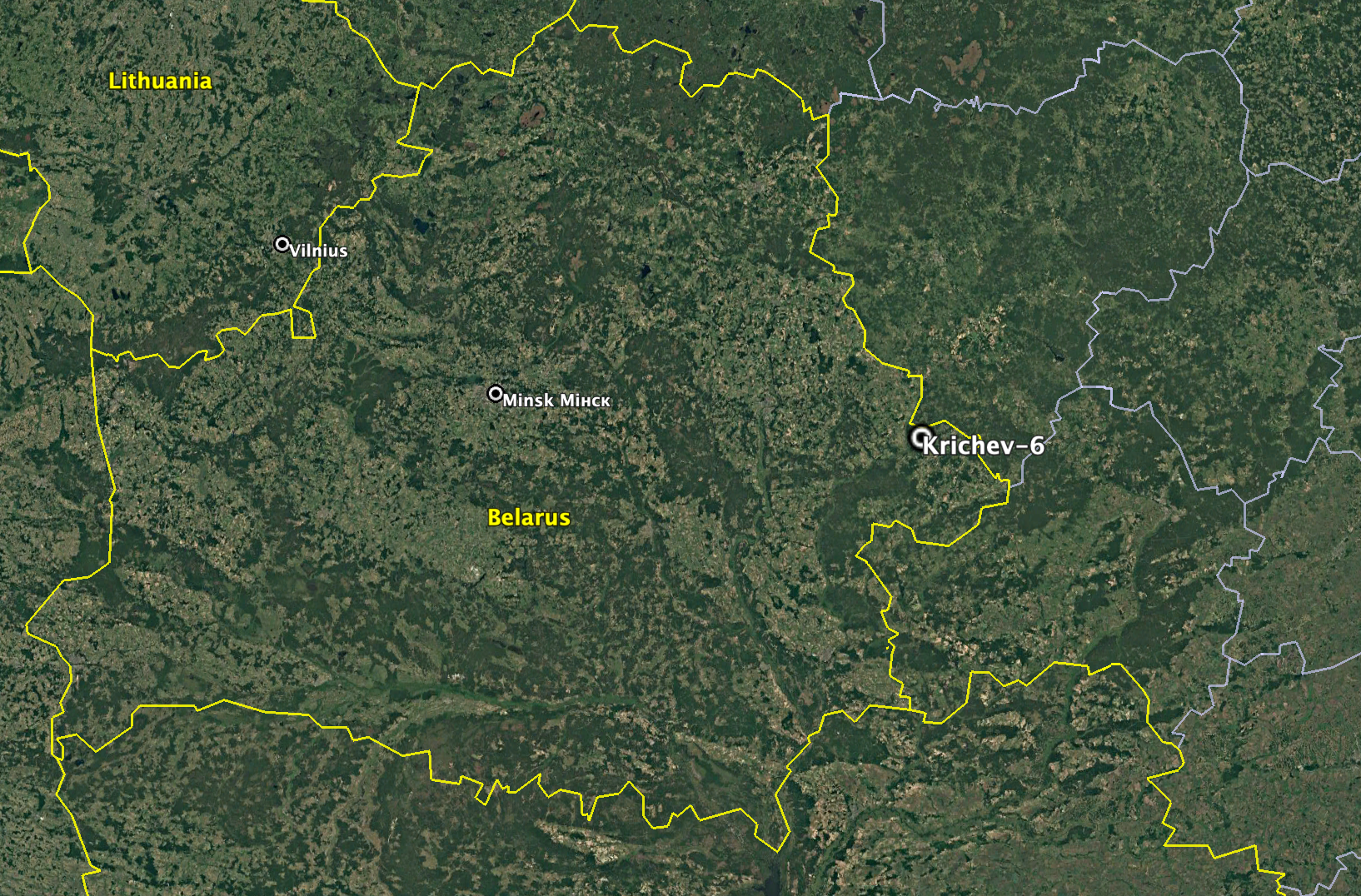
I would say that "a brigade has been formed" is pretty far from "missiles have been delivered to Belarus where they are entering combat duty." I am far from suggesting that Oreshnik is a phantom missile - the evidence suggests that it is not. But at the same time, I do believe that we should be very skeptical about reports of its deployment in Belarus. I find it very hard to believe that the Strategic Rocket Forces, which are expected to operate the missile, will be happy about being stationed outside Russia. Besides, the case for the military utility of the deployment is virtually non-existent. Note that the Krichev-6 site is literally seven kilometers from the Russian border (see the image above).
The "division of labor" between Russia and Belarus regarding virtually all news about Oreshnik also makes me suspicious. We have seen a similar pattern with nuclear weapons - Russia lets Belarus make all kinds of statements about them and even builds a storage facility that should be capable of accepting these weapons if necessary. But there has been no confirmation of the deployment from the Russian side and there are no signs of weapons being actually delivered to Belarus (I believe they will never be deployed there, but that's a topic for another post). The same seems to be the case with the missile base. The infrastructure, of course, could become useful someday, but we are not there yet. For the moment, it appears that both sides are involved in a rather strange political spectacle. I still hope that it will not involve actual movements of missiles (not to mention nuclear weapons), but we cannot exclude that it will.
UPDATE: On 30 December 2025, the Ministry of Defense announced that the first Oreshnik unit was deployed in Belarus. The MoD released a video that showed a ceremony of a unit beginning the combat duty. The site was later confirmed to be Krichev-6, identified earlier. The video, however, does not show any launchers or missiles.
The book

Post a comment