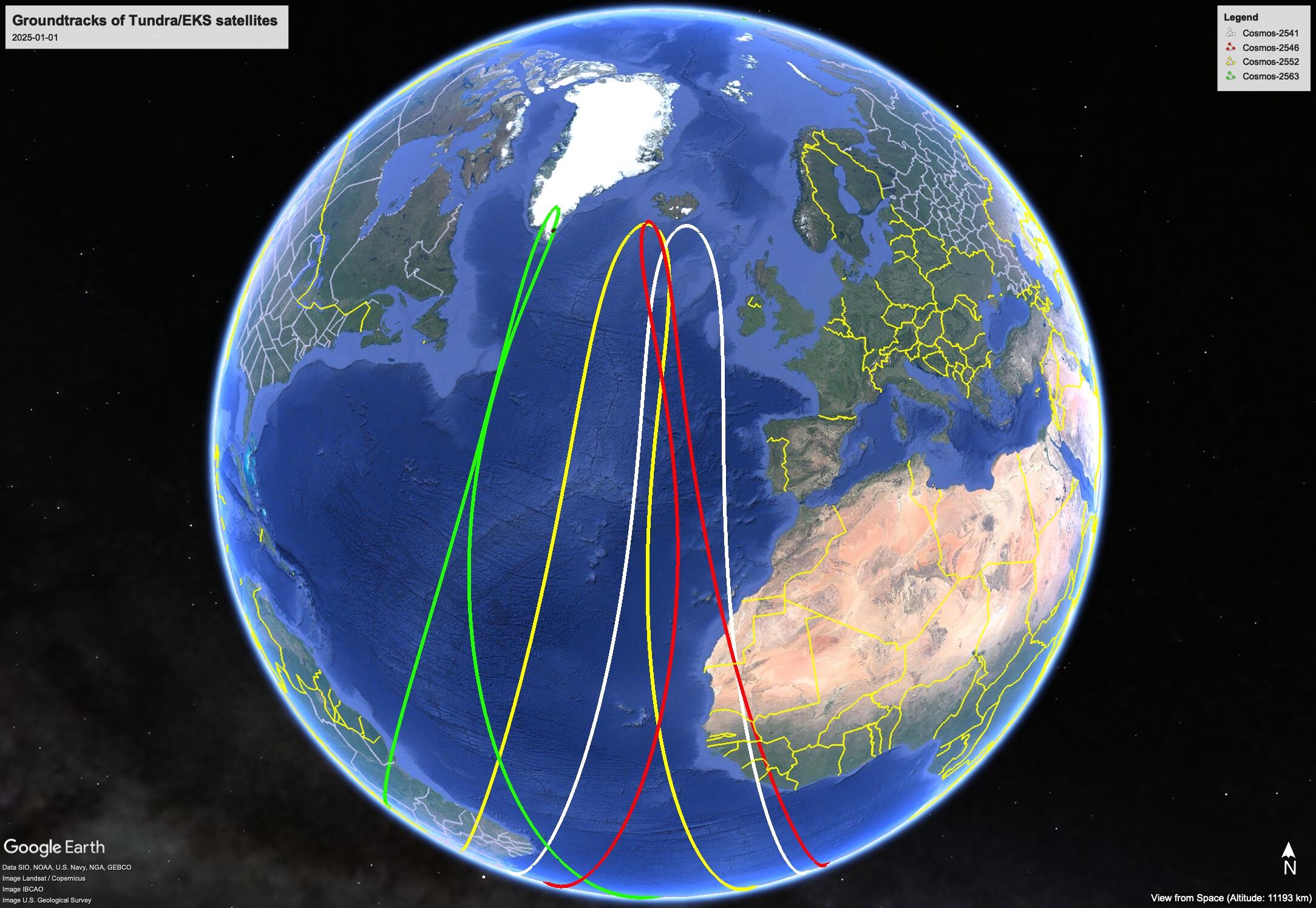
 The earlier post about the status of the space-based segment of the Russian early-warning system got some media attention, which led colleagues to question my conclusion. And they may have a point - it may be a bit early to write these satellites off.
I was looking at the mean motion (the number of revolutions a day), which was a very good indicator of a working status of satellites of the earlier generation. The old Oko satellites had to be rather meticulous about station keeping as they were detecting missiles against the background of space (see this article for details). Tundra satellites apparently have true look-down capability, so they are more flexible with their orbits. Bart Hendrickx has a great overview of the Tundra/EKS satellites.
Since the notion of a station is different for Tundra satellites, the fact that we don't see standard orbit corrections does not necessarily tell us that the satellite stopped functioning. Jonathan McDowell noted that apogee longitudes of the four most recently launched satellites - Cosmos-2541, Cosmos-2546, Cosmos-2552, and Cosmos-2563 - haven't changed much--unlike those of Cosmos-2510 and Cosmos-2518, which are clearly off station.
Scott Tilley made a similar observation, also looking at apogee longitudes. He noticed, though, that starting around September 2025 all four satellites are shifting their apogees west. Since all four started the movement at the same time, Scott suggested that it's a planned maneuver to take satellites to a station that is easier to maintain, rather than a sign of dysfunction. Furthermore, he registered radio activity consistent with historical on-orbit operations and noted that there are no signs of uncontrolled behavior.
These are fairly convincing arguments, so it's quite possible that I jumped the gun in declaring the satellites non-operational. But maybe not--my understanding is that station-keeping for these kinds of orbits is a rather delicate process and a failure to perform distinct regular maneuvers is a sign that a satellite is not quite well. The groundtracks (see the image) also do not quite suggest a healthy constellation. But maybe that's because I've seen too many graphs of Oko satellites' mean motion. The current constellation is different. I guess the situation will be clearer in a few months.
The book

Post a comment