 Accidents that involve nuclear weapons inevitably draw attention as they remind us that the nuclear enterprise is inherently dangerous. There is a good argument that nuclear operations are prone to what Charles Perrow called normal accidents. Scott Sagan covered nuclear weapons in detail in his book "The Limits of Safety." The book, of course, looked at US accidents and the lessons learned from US nuclear operations. It would be interesting and valuable to compare it to the Soviet and Russian record.
As one can expect, there is not much information about Soviet and Russian accidents. But there is some. I tried to collect these bits in a working paper that was prepared for a workshop "Nuclear Crises Revisited" organized by the Managing the Atom program in February 2024. Managing the Atom will eventually publish all contributions as a book, which will cover many other accidents and nuclear crises, from US false alarms to Berlin in 1961 and US-North Korea in 2017. It will be a very interesting volume.
My paper covers early nuclear weapons handling arrangements, Soviet approach to command and control adopted in the early 1970s (with the reliance on a deep second strike and then on a launch from under attack). Of course, I look into the 1983 Colonel Petrov accident and the 1995 Black Brant event. There were other accidents as well, for example, Soviet Union's own "training tape" incident in 1978, in which an early-warning center in the Far East (most likely Mishelevka) was showing a visiting party boss how the system operates. There was also a noteworthy event in 2013, with an Israeli Arrow test. My overall conclusion is that a reasonably good design of the command and control system and the assumption that a bolt out of the blue attack is highly unlikely can go a long way to preventing the worst.
I also look at some known accidents in which nuclear weapons could have been damaged. As far as we know, these were fairly rare. If you compare it to the US record, it is clear why. Unlike the United States, the Soviet Union apparently had never flown its bombers with nuclear weapons on board. Nuclear tests in which weapons were delivered by an aircraft were, of course, the exception, but in those the bomber would land empty. One known incident is the aborted test of the first thermonuclear bomb, RD-37, in November 1955. Because of the weather conditions the Tu-16 bomber had to land with the weapon on board, which almost gave everyone involved in the test a heart attack. This may have been the only landing with a live nuclear weapon on board. At least I haven't seen anything that would suggest otherwise.
Not surprisingly, the majority of accidents happened with naval weapons. The Soviet Union lost three submarines with 25 weapons on board. Loading operations, of course, were particularly dangerous. There was a missile fire in Vilyuchink in September 1976, in which a warhead of an R-29 missile was sent to the bay by an explosion. I also have oral accounts of other incidents. In one, a torpedo (or a cruise missile) was accidentally launched during loading on a surface ship. It safely landed on the other side of the bay (it was one of the Northern Fleet bases). In another loading (or, rather, unloading) incident, a missile caught fire while being handled by a crane. This apparently happened some time in the 1990s. I didn't include these in the paper since I couldn't find a documented account of these events.
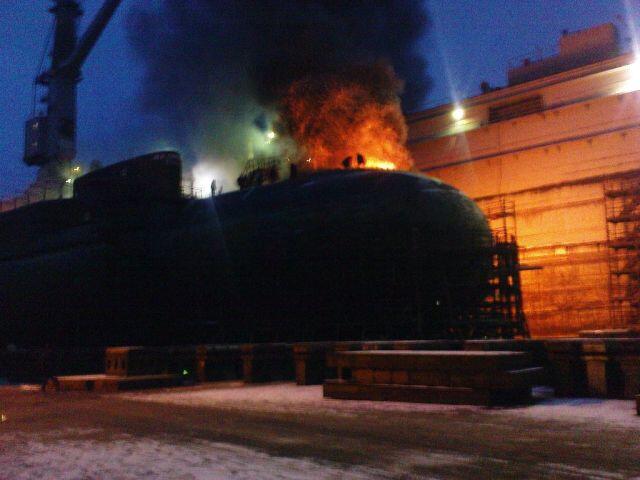
There is also no direct evidence of the severity of the 2011 fire on the Yekaterinburg submarine. But the circumstantial evidence is fairly strong - it appears that the submarine had missiles (with nuclear warheads) on board at the time it caught fire.
The Rocket Forces had their share of accidents as well, although not nearly as many as the navy. There were two explosions of UR-100/SS-11 missiles in silos in 1967. Other than that, there are no accounts of problems with ICBMs. Interestingly, there have been no reported serious accidents with mobile ICBMs, although there have been accounts of launcher rollovers. I think there is even a photo of it somewhere.
Of course, it would be good to have a detailed official account of the accidents. But even what we have allows us to draw some conclusions. The main ones are: think about your command and control procedures, don't keep your nuclear forces on hair-trigger alert, don't move nuclear weapons around. Ideally, just put them in some bunker under lock and key, but we are probably rather far from this solution.
Image: Fire on the Yekaterinburg submarine in December 2011. Posted on the airbase.ru forum.
The book

Post a comment