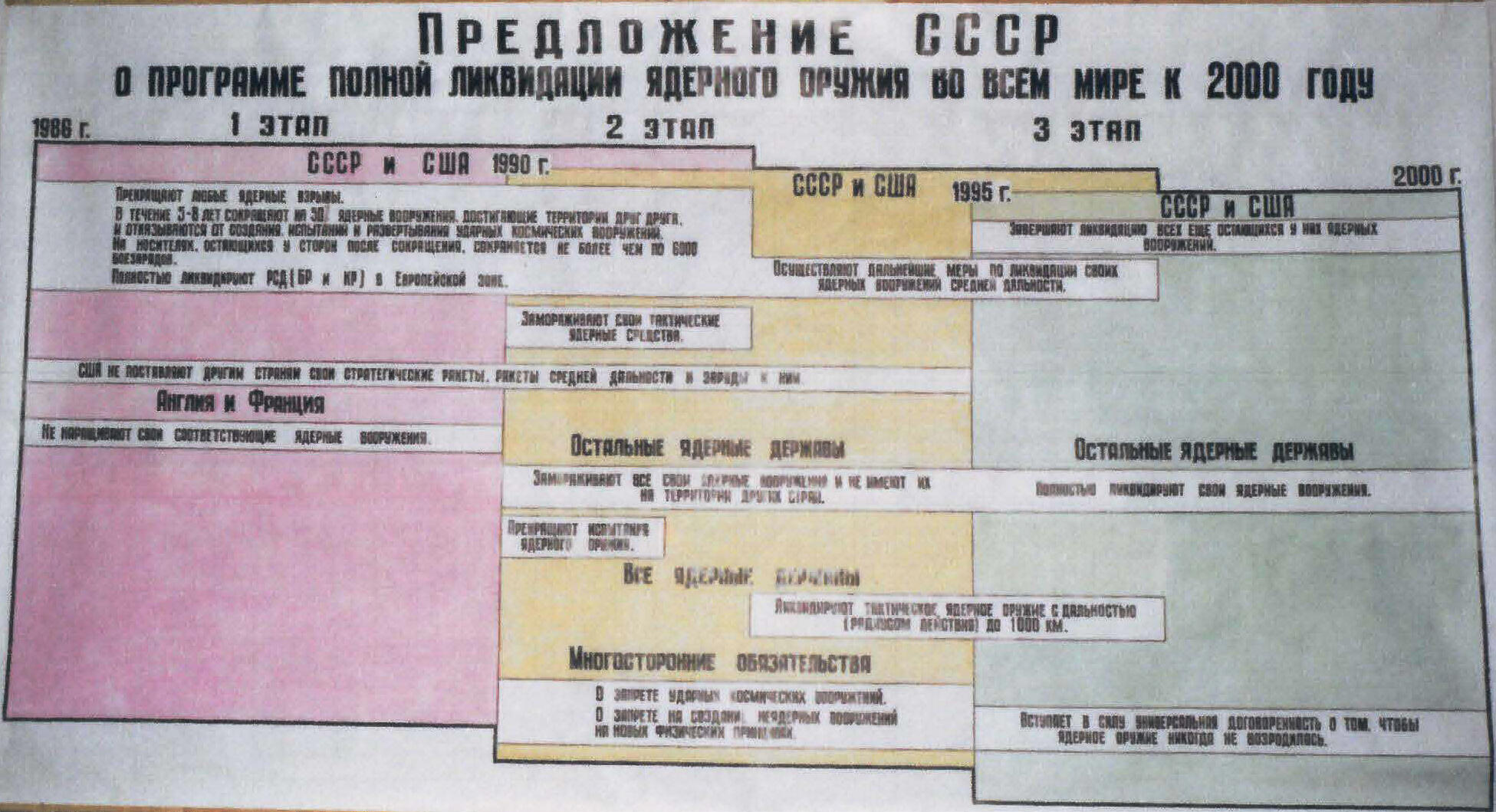
 Forty years ago, on 15 January 1986, Mikhail Gorbachev announced a plan to eliminate all nuclear weapons by 2000. The next day, the Ministry of Defense and the Foreign Ministry held a joint briefing, at which Georgy Kornienko (First Deputy Foreign Minister) and Marshal Sergei Akhromeyev (Chief of the General Staff) presented the plan. (And I think I was watching it live on Soviet TV.)
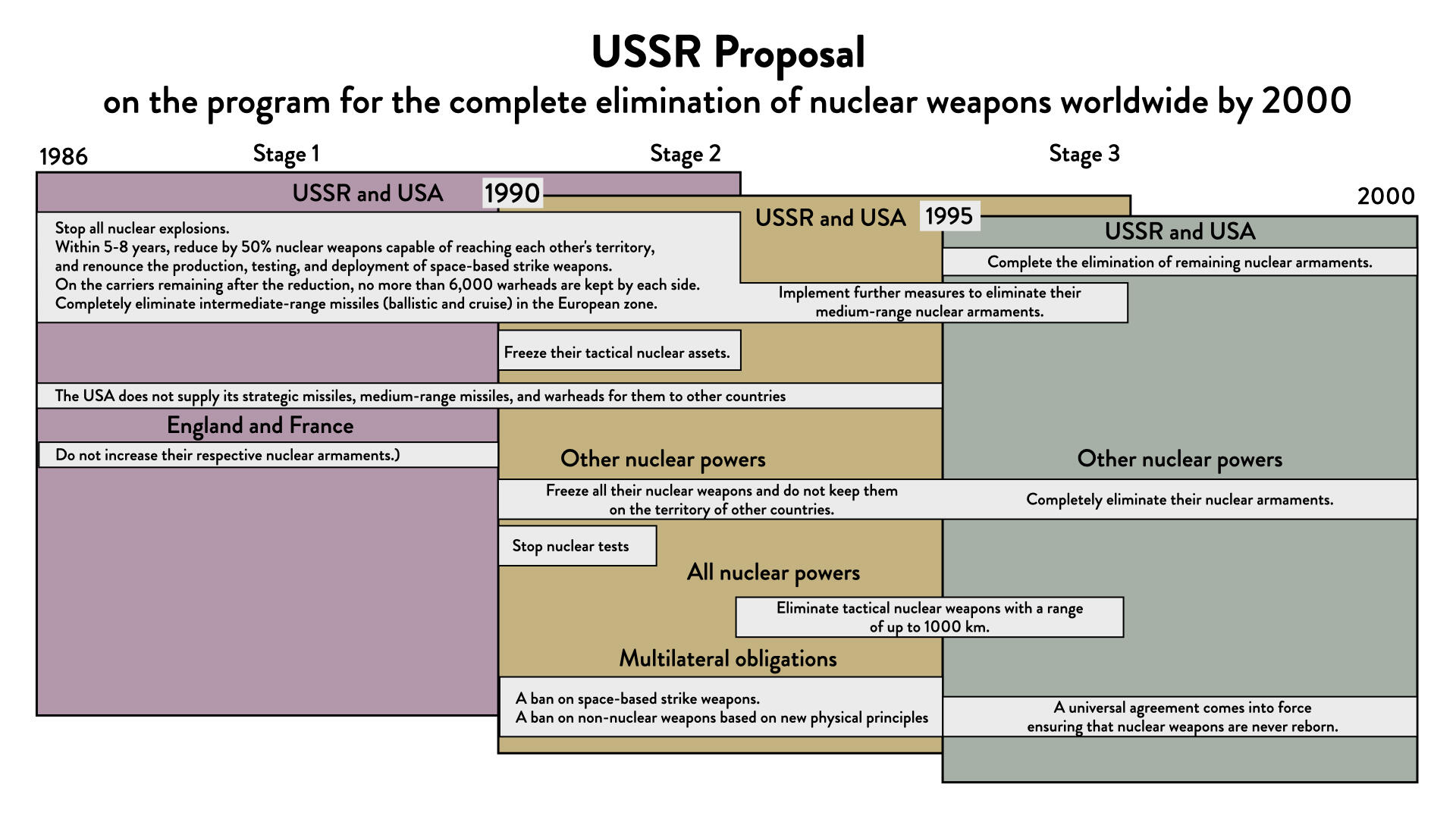
The image above is, I believe, a photo of the poster that they used during the briefing. The poster is not quite a masterpiece of graphic design, but it's generally in line with the style common in the Soviet military. (The English design below was put together by Alex Glaser.)
The origins of the plan are quite interesting and even Soviet participants of the event disagree on whether it was just a propaganda move or a serious proposal. My take is that there was a bit of both, but it was definitely an attempt to step back from confrontation. It's worth noting that the proposal took its final form after the first Reagan-Gorbachev summit in Geneva in November 1985, but before the Reykjavik meeting in October 1986.
Of course, many members of the Reagan administration were deeply skeptical about all this (to put it mildly). However, George Shultz saw it differently. Here is how he described his conversation with the president the day when they learned about the proposal:
I said to President Reagan, "This is our first indication that the Soviets are interested in a staged program toward zero. We should not simply reject their proposal, since it contains certain steps which we earlier set forth." The president agreed. "Why wait until the end of the century for a world without nuclear weapons?" he asked. He recalled that he had, in fact, made that statement to Gorbachev in the pool house at Fleur d'Eau [in Geneva].
The plan suggested disarmament in three stages:
Stage 1 (1986-1990): The United States and the Soviet Union would stop nuclear testing, reduce their strategic nuclear arsenals by 50% (leaving no more than 6000 warheads), eliminate all medium-range missiles in Europe. The United States commits not to transfer their strategic and intermediate-range missiles and their warheads to other states. The UK and France would freeze their arsenals.
Stage 2 (1990-1995): The United States and the Soviet Union continue the elimination of their intermediate-range missiles and take the process further (maybe to Asia?). They also freeze their tactical nuclear arsenals. Other nuclear powers would join the process. Other nuclear states (presumably the UK and France) would freeze their arsenals and commit not to deploy their weapons on the territory of other states. They stop all nuclear tests. All nuclear weapon states (not clear if it was meant to include China) would start the elimination of all tactical weapons with the range of less than 1000 km (this process was expected to continue after 1995). In addition to this, there will be a multilateral agreement to ban strike weapons in space and on non-nuclear weapons based on new physical principles.
Stage 3 (1995-2000): The United States and the Soviet Union complete the elimination of all remaining nuclear weapons. Other nuclear weapon states eliminate their nuclear weapons as well. At the end, a universal agreement comes into force ensuring that nuclear weapons are never reborn.
Of course, the plan was not realistic. But on the other hand, a lot of its elements became reality: the INF Treaty, START, the Comprehensive Test Ban Treaty. Even the UK and France ended up not just freezing but actually reducing their arsenals. So, I guess it pays to be bold.
The book

Post a comment