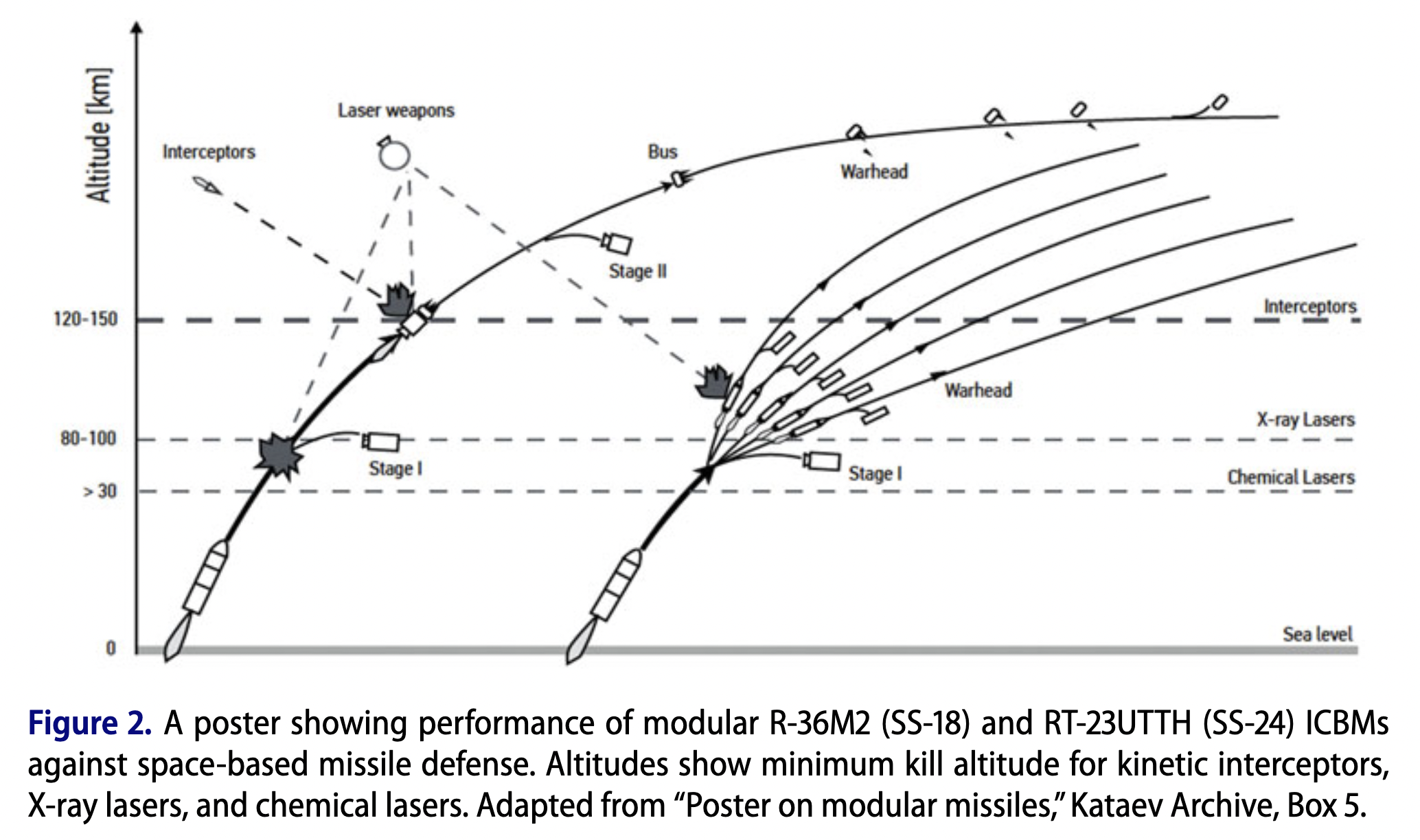
 Although the Golden Dome will soon mark its first anniversary, there is still not much clarity on what the system will consist of, what it will be asked to do, or, more importantly, what it will be able to do. One idea, however, surfaces with some regularity - space-based missile defense. This does not mean that this idea has some promise - the physics hasn't changed since the last time it was discussed in the 1980s. Building a system that would be even marginally capable is still prohibitively difficult.
The current enthusiasm about space-based defense largely stems from the fact that the launch cost has been reduced quite dramatically and constellations of thousands satellites do not seem particularly impossible. Another reason to believe that the idea of space-based defense will get some traction is that it would be relatively easy to arrange a test of the capability (especially if it does not involve an actual intercept). Finally, space-based missile defense could provide anti-satellite capability, which some people in the US seem to find useful.
As for the actual missile defense capability that the Golden Dome would provide, it is always useful to remember that missile defense works perfectly ... against missiles that don't exist. This was the lesson from the 1960s, when it turned out that missile defense systems of the time cannot do anything with actual ICBMs that both the United States and the Soviet Union started producing "like sausages" (well, almost). This was also the case in the 1980s, when the US plans to build Strategic Defense Initiative led Soviet designers to see how they could make the life of SDI complicated.
The image on top shows what they came up with - it is a translation of one of the slides in the Katayev archive (it's from my article about Soviet response to SDI). The idea was rather simple - to create more targets for the space-based missile defense layer, they suggested "modular missiles" that would have several second stages to deploy their warheads.
The estimate, which was completed ca. 1987 suggested that the modular scheme would not dramatically reduce the number of warheads that the missiles can carry. At the same time, it would significantly improve the chances of penetrating the space-based layer of missile defense. The two tables below are taken from the same document in the Katayev archive.
Estimated missile defense penetration effectiveness of R-36M2 and RT-23UTTH missiles with MIRVs and modular configurations
| RVSN missile forces (after reductions), with R-36M2 and RT-23UTTH missiles | Warheads penetrating space-based missile defense (% of launched warheads) | ||
|---|---|---|---|
| Interceptors | Interceptors and lasers | ||
| Missiles with MIRVs, enhanced survivability, and shortened boost and post-boost phases | R-36M2 | 13 ... 16 | 5 ... 6 |
| RT-23UTTH | 13 ... 28 | 6 ... 15 | |
| Modular missiles | R-36M3 | 70 ... 75 | 65 ... 70 |
| RT-23M | 40 ... 45 | 35 ... 40 | |
| Note: Modular missile configurations improve penetration effectiveness against U.S. space-based missile defenses by a factor of 4.5-14 for R-36M3 missiles and 1.5-6.5 for RT-23M missiles, compared to other measures. | |||
R-36M2 and RT-23UTTH missiles with MIRVs and modular configurations
| Specification | R-36M2 | RT-23UTTH | ||
|---|---|---|---|---|
| MIRV | Modular | MIRV | Modular | |
| Launch weight, tonnes | 211.2 | 211 | 105 | 105 |
| Throw weight, kg | 8,740 | 6,400 | 3,650 | 3,200 |
| Number of warheads | 10 | 8 | 10 | 5 ... 10 |
The second table shows that this improvement in counter-missile defense performance would not have led to a significant degradation of the missiles' capabilities. R-36M3 would carry eight warheads instead of its regular ten, but the launch weight would not have changed, probably meaning that the missile could have been deployed in the same silos. Things were a bit different for R-23, but not too much.
A colleague noted that all these numbers should be taken with a (big) pinch of salt. I agree, of course. The point is that these kinds of estimates supported the case that the Soviet Union should not worry too much about the SDI program. Since these estimates were produced internally, by the same institutions that were in charge of building missiles, they allowed the political leadership to "untie" missile defense from disarmament discussions (INF and START). They showed that any missile defense eventually meets a missile against which it doesn't quite work.
The book

Post a comment