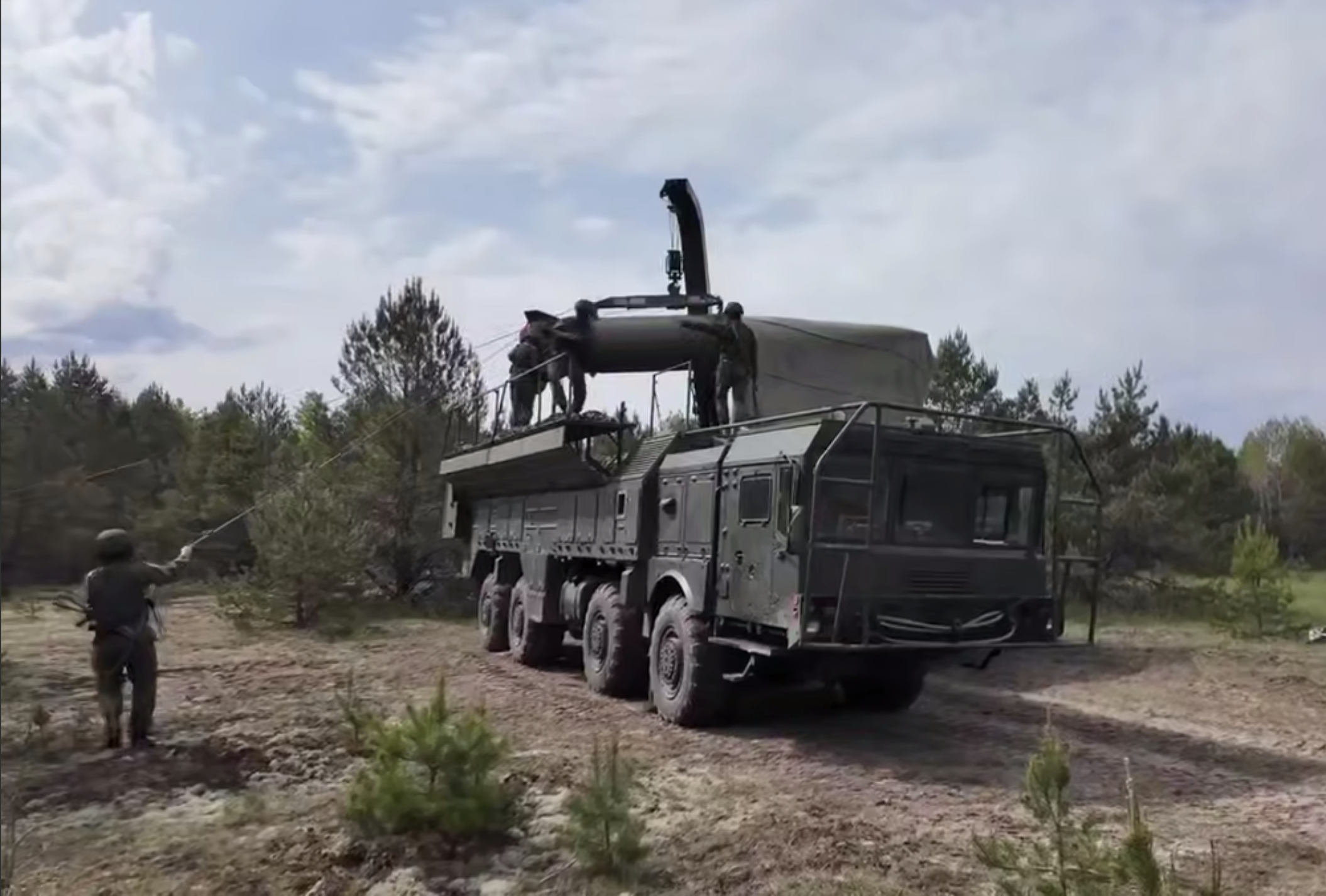
 On 18 May 2026, the Belarusian Ministry of Defense announced the start of an exercise of "military units involved in the combat use of nuclear weapons and nuclear support." The objective was described as checking the readiness of the troops and "the organization of the combat employment from unplanned areas." The announcement said that the exercise will test the procedures of "delivery of nuclear weapons and their preparation for use," which will be done in coordination with the Russian military. The Russian Ministry of Defense did not say anything about its role, although the 12th Main Directorate took notice of the Belarusian exercise.
The next day, on 19 May 2026, the Russian Ministry of Defense announced that it will hold its own large-scale exercise "to prepare and use nuclear forces in the face of the threat of aggression" in the period of 19-21 May 2026. It was said to include "over 200 missile launchers, more than 140 aircraft, 73 surface ships, and 13 submarines, including 8 strategic missile submarines." Belarus' participation was mentioned as well.
The strategic part of the exercise apparently had to wait for the Russian president to return to Moscow from his visit to China. But the non-strategic element went ahead without him.
On 20 May 2026, the Russian MoD released a video (probably recorded on 19 May) of its units involved in various activities. The announcement stated that "the delivery of nuclear munitions to field storage points of missile brigades' positioning areas was ensured." The missile brigades in question apparently were those with Iskander cruise missiles, shown in the video (by the way, the containers appear to be Type 3 in Jeffrey Lewis' classification).
All this was separate from what was happening in Belarus. Russian MoD mentioned training related to "nuclear weapons deployed in Belarus," but made it reasonably clear that it is a separate activity. According to the Belarusian MoD, on 20 May 2026, the combat crews of units that operate Iskander ballistic missiles "carried out a set of measures to prepare for the receipt of special munitions and their mating with missiles." It is not entirely clear whether these measures were limited to preparations or the actual receipt and mating took place. My reading of the text is that it is the former - no Russian troops that would deliver the weapons are mentioned. The announcement also mentions aircraft, which (two Su-25) were also in the video. The aircraft were said to perform "imitation bombing with special munitions," but there was nothing to suggest that Russian 12th GUMO units were there to deliver anything.
The Russians apparently came at night. The video released by the Belarusian MoD in the morning of 21 May 2026 showed what was identified as trucks of the 12th GUMO. They appear in the second half of the video (the first half shows some Belarusian trucks that do not seem to have anything to do with anything). The video appears to show personnel opening armored back doors of the truck, probably to prepare the warhead for mating with the missile.
A few words about how the preparation for use of Iskander ballistic missiles appears to be structured. Missiles and warheads arrive at the designated meeting point (apparently the "field storage points" mentioned earlier) separately. In this case, missiles are operated by the Belarusian military, in Russia these would be Russian units. Warheads, however, are always handled by the 12th GUMO personnel. Once at the meeting point, the 12th GUMO troops mate warheads with missiles. This procedure may require a special assembly bench, but it's possible that it can be done while the missile is on the transporter vehicle.
Once the warhead is on the missile, the transporter is probably guarded by the 12th GUMO crews. When the higher command orders bringing the system to the highest degree of readiness, which may include authorization to launch the missile at a designated target, the missile and nuclear crews transfer the missile from the transporter to the launcher. As I understand it, it would be after this procedure that the 12th GUMO transfers custody of the nuclear warhead to the missile crew, Belarusian in this case. Not earlier.
The procedure of releasing weapons to aviation is probably similar, the main difference being that there is no need to transfer a weapon to a transporter vehicle. The procedure with Iskander cruise missile must be different, since the missile is stored and transported in a container and the weapon section is not easily accessible. And that difference may account for the fact that there are no cruise missiles that have nuclear warheads assigned to them in Belarus. But that is for another post.
This procedure does not require nuclear warheads to be stored near missiles. Indeed, I believe that the plan is that if time comes the warheads would be brought to Belarus from Bryansk. It is a drive that can take several hours, but it is not that unusual for the 12th GUMO. There is also an option of keeping warheads at the storage site in Asipovichi, but we have not seen a confirmation that this is what is being done.
Now, naturally, one would assume that these kinds of exercises do not involve actual nuclear weapons and everything is done with training models. But that is not what the Chief of the General Staff said on 21 May 2026 before the strategic part of the exercise (my translation):
In the first phase of the exercise, from May 19 to 20, a snap exercise of nuclear forces was conducted. Troops and forces were brought to the "Full" combat readiness, and the delivery and transfer of nuclear munitions to Russian and Belarusian units that can use nuclear weapons in combat was carried out.
This seems to suggest that the exercise went as far as to actually get to the point of mating actual warheads with missiles and loading these missiles on launchers. I hope it didn't proceed to transferring the custody of weapons to the Belarusian crews.
In any event, moving live nuclear weapons around during exercises is not a good idea. The United States, of course, did a lot of this and much worse, like having continuous bomber patrols with nuclear weapons (and a lot of accidents). Interestingly, France uses actual nuclear warheads during exercises but only within the airfield. My impression has always been that Russia is on the side of caution in these matters. Maybe not anymore. Some guardrails, however, still seem to be in place, like not flying with nuclear weapons.
To conclude, there is still a puzzle about the timing of the exercise. Why did Belarus start a day early? Note that the Chief of the General Staff said that the first part of the exercise, from 19 to 20 May, was a "snap exercise." I would say it is not entirely impossible that Belarus in a way forced Russia to add the non-strategic part to the strategic exercise it was planning for some time. I would recall that in 2024, Belarusian president in effect invited his military to the exercise that Russia announced. I am not saying this is what happened, though.
Much more important questions are, what happened to all those nuclear warheads that have been "delivered and transferred" to the units that can use them. Are they still there? They could probably stay in those "field storage points" for some time, maybe weeks. And what are those "conditions of a threat of aggression"? I guess we will know in a few days.
The book

Post a comment