 Three media outlets - the Sunday Times, Danwatch, and the Dossier Center - published stories about the facility at Kosvinsky Kamen, which is part of the system often referred to, not quite correctly, as the Dead Hand or Perimeter. These stories were picked up by many other news organizations and commentators, often framed as being about the return of the Dead Hand system or as a sign of renewed concerns about US decapitation strikes.
This is a wrong reading, though. You cannot reactivate the Dead Hand since it has never been deactivated. While the evidence does show that Russia recently completed a significant upgrade of the Kosvinsky Kamen facility, nothing suggests that this has changed the basic principles of the Russian command and control system in any way. Neither does this project indicate "paranoia" on the part of the Russian leadership. A survivable command and control system is a normal and even essential part of nuclear force operations.
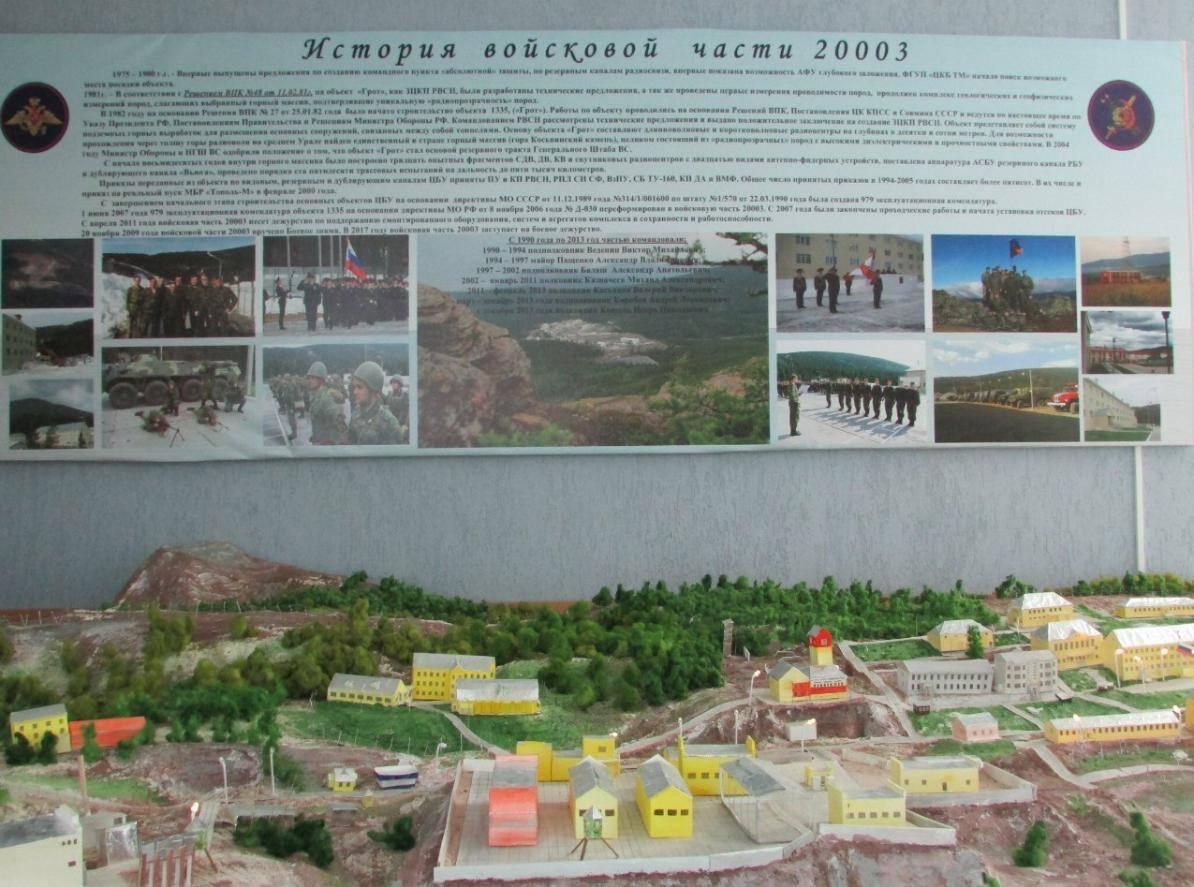
Of the three stories, the Dossier Center one is the most interesting and detailed. It is also the one that avoids the "reactivation" framing (full disclosure - I'm quoted in the story). They also found and published a photo of a poster that shows a fairly detailed chronology of the Kosvinsky Kamen facility, formally known as Object 1335 and operated by military unit 20003. The story is in Russian, but this shouldn't be a problem these days.
First, a brief recap. What is known as the Dead Hand is the general approach to nuclear command and control that was developed in the Soviet Union and, by all indications, is used by Russia today. Since the early 1970s, the primary mode of operation of Soviet strategic forces was retaliation after ride-out. To support a retaliatory strike, the command and control system included a variety of communication channels and reserve command posts. Once a nuclear attack was detected by the early-warning system, the national command authority could issue a so-called preliminary command, which would enable the transmission of an actual launch order. The command centers would then wait for the launch order from the central command post. To guard against decapitation, the command centers could issue an order independently, provided communication with the leadership was lost and they had positive confirmation of an attack, such as the detection of nuclear detonations on Soviet territory.
Perimeter is only one of many communication systems that are used to deliver the launch command to launchers. It includes several command missiles that would fly over the country, delivering the launch order directly to missile silos (and, in later versions, to mobile missile regiments, submarines, and bombers). Those silo-based missiles that survived an attack would launch automatically without the crew going through the launch procedures.
Similarly, the Object 1335 facility is only one of many reserve command posts. Since it is built to withstand a direct nuclear strike (a command post of "absolute" protection), it is an important element of the command and control system but not the only one. For example, the system is known to include airborne command posts.
The system's Dead Hand reputation comes from its ability to deliver the launch order even after a decapitating strike, that is, without an explicit order from the national command authority. The algorithm also makes it possible in principle to operate the system in an automated mode: once the preliminary command is issued, all that is required is confirmation of an attack, with no further human input. This is not that far from the Doomsday Machine as depicted in Stanley Kubrick's Dr. Strangelove.
We know from a Soviet document that the system was not operated in automatic mode back then. The document complained that insufficient attention was being given to the proposal. But even in this proposal, the system would be switched to automatic mode only in the event of a crisis (during a "threatening period"). Presumably this would be done by issuing the preliminary command when the crisis begins (and informing the adversary of it). Normally, the preliminary command would be issued only after a missile attack is detected.
The Dossier Center story quotes a publication by Major-General (ret.) Victor Khalin, who participated in the upgrade of the Object 1335 facility after 2005. According to Khalin, after the upgrade, the system can work "both in automated and in automatic mode" ("как в автоматизированном, так и в автоматическом режиме"). This is not an entirely new capability, however--it existed back in the 1980s as well. Moreover, as far as this (or any other) reserve command center is concerned, the difference between these two modes is not particularly large. If the idea is to issue a launch order when a set of conditions is met, does it really matter how the key is turned? Is it done by an operator sitting deep in a mountain after looking at a red light on the instrument panel, or by the signal from that red light going to the key circuitry automatically?
The automation we should worry about is elsewhere. In the Soviet and Russian case, it is at the point of assessing the early-warning data and issuing the preliminary command. In the United States it's the assessment of the early warning. These steps are already automated, and this is where making things automatic can be a real problem. And the earlier question applies here as well--if people performing the assessment or making the decision act automatically, it may not matter if they are in the loop. There are, of course, examples of operators acting reasonably. The Stanislav Petrov episode is one (even though it's more complicated than usually thought). Another was described by Valery Yarynich in his book: when the Rocket Forces Command Center issued an erroneous preliminary command, only one missile division went through the procedures and raised the readiness level. Others recognized it as an error.
Going back to Object 1335, the chronology of its operations, as seen on the poster found by the Dossier Center, leaves no doubt that the facility has been operating for some time and was never deactivated. The recent modernization probably expanded its capabilities, but nothing suggests that its function has changed.
Below is the translation (by Claude) of the chronology as it appears on that poster. The Russian-language text is in a separate file.
History of Military Unit 20003
1975-1980
The first proposals are put forward for creating a command post of "absolute" protection, using reserve radio-communication channels; the feasibility of deeply-buried antenna-feeder systems (AFU) is demonstrated for the first time. FSUE "TsKB TM" (Central Design Bureau of Heavy Machine-Building) begins the search for a possible site.
1981
Under Military-Industrial Commission (VPK) Decision No. 48 of 11 February 1981, technical proposals are developed for the "Grot" object as a backup central command post (ZTsKP) of the Strategic Rocket Forces (RVSN). The first measurements of the rock's conductivity are carried out, together with a set of geological and geophysical measurements of the chosen mountain massif, confirming the rock's unique "radio transparency."
1982
Under VPK Decision No. 27 of 25 January 1982, construction of Object 1335 ("Grot") begins. The work proceeds on the basis of a VPK Decision, a resolution of the CPSU Central Committee and the USSR Council of Ministers, and continues to the present day under decrees of the President of the Russian Federation, government resolutions, and decisions of the Minister of Defense. The object is a system of underground mine workings housing the main structures, interconnected with one another. Its core is formed by long-wave and short-wave radio centers at depths of tens to hundreds of meters. To allow radio waves to pass through the mass of the mountain, the only suitable massif in the country was found in the Central Urals (Mount Kosvinsky Kamen), composed entirely of "radio-transparent" rock with high dielectric and structural-strength properties.
From the early 1980s
Inside the massif, thirty experimental fragments of VLF, LF, HF and satellite radio centers were built, with twenty types of antenna-feeder devices. Automated combat-control (ASBU) equipment was installed for the reserve channel (RBU) and the duplicating "Vyuga" channel, and around 150 path (over-distance) tests were conducted at ranges up to five thousand kilometers.
1989-1990
With the completion of the initial construction phase of the main objects, under USSR Ministry of Defense directive No. 514/1/001600 of 11 February 1989 and staffing table No. 1/579 of 22 March 1990, the 979th Operational Commandant's Office is created.
Around 1990
The first construction phase of "Grot" is completed around this time, after roughly eight years of work inside Kosvinsky Kamen. The pace of construction then falls off sharply.
February 2000
A command for a real launch of a "Topol-M" ICBM is transmitted through the object. (In all, more than 500 orders were accepted over 1994-2005 across the primary, reserve and duplicating channels by the control and command posts -- those of the Strategic Rocket Forces, the strategic missile submarines of the Northern Fleet, the airborne command post, the Tu-160, and the command posts of Long-Range Aviation and the Navy.)
2004
The Minister of Defense and the Chief of the General Staff approve a provision under which the "Grot" object becomes the basis of the reserve channel of the General Staff of the Armed Forces.
June 2007
Under RF Ministry of Defense directive No. D-030 of 8 November 2006, the 979th Operational Commandant's Office of Object 1335 is reorganized into military unit 20003. From 2007, commissioning work is completed and installation of the combat-control center (TsBU) begins.
20 November 2009
Military unit 20003 is presented with its Battle Banner.
From April 2011
Military unit 20003 stands duty to keep the installed equipment, systems and assemblies of the complex intact and operational.
2017
Military unit 20003 goes on combat duty.
The book

Post a comment